
Comment:
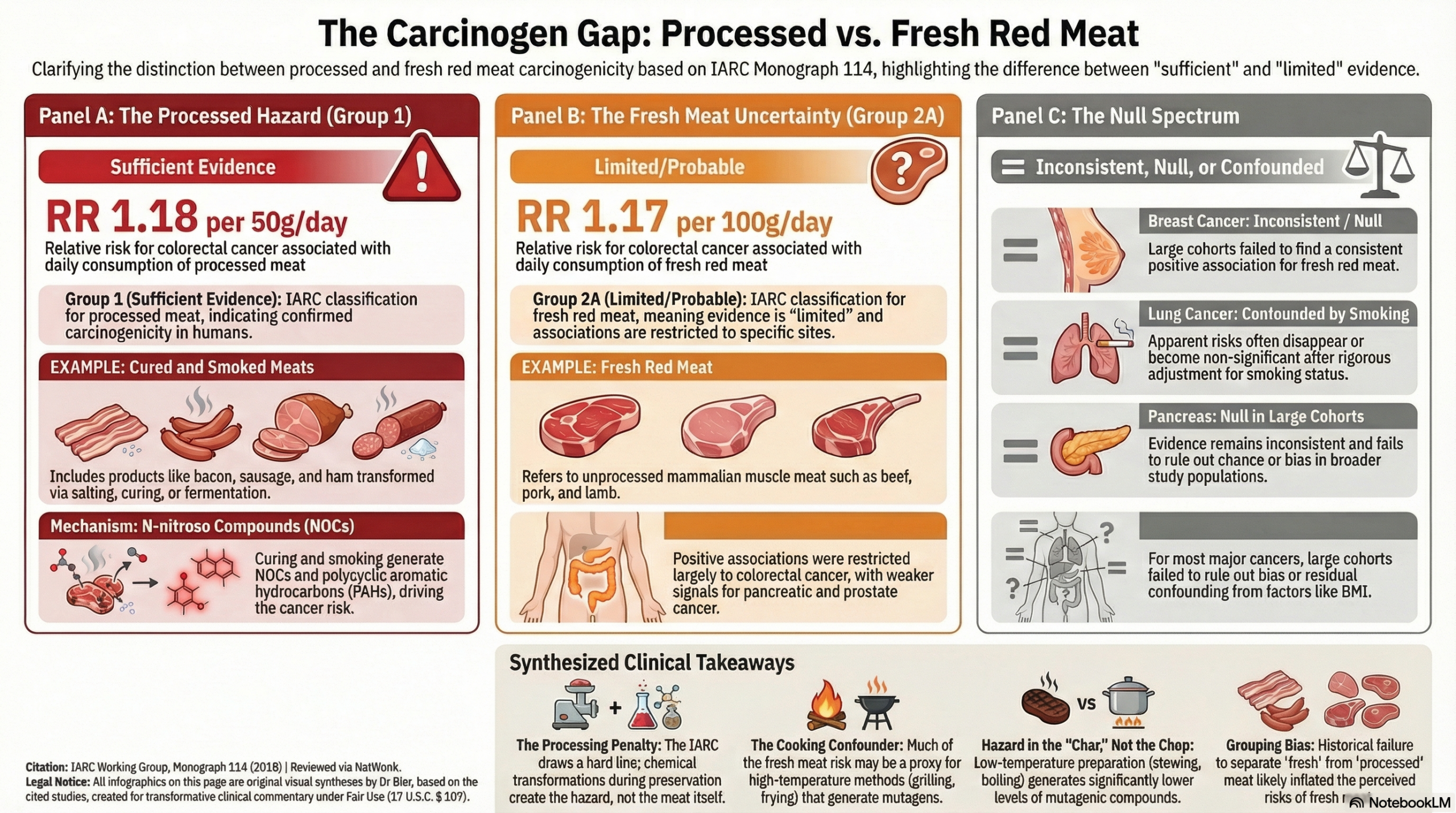
The traditional clinical focus on a generic “meat-cancer link” ignores the underlying reality that preserved meats and fresh red meats are entirely different biological entities. While the IARC Working Group found sufficient evidence for processed meat as a Group 1 carcinogen—linked to the formation of N-nitroso compounds (NOCs)—the evidence for fresh red meat remains stubbornly “limited.” We should be deeply skeptical of any narrative that equates the consumption of a fresh steak with that of cured, salted, or fermented meats.
This IARC Monograph deconstructs over 800 studies to reveal a profound discrepancy: while processed meat is classified as a Group 1 carcinogen due to added nitrates and nitrites, the Group 2A “probable” classification for red meat is heavily compromised by “grouping bias.” For years, I have cautioned that many epidemiological findings are suspect because they fail to isolate fresh red meat from preserved meats like bacon or sausages. We should recognize that the reported risks for “total red meat” are frequently driven by these processed components rather than the meat itself.
And the associations are not across the board. Processed meat (which I haven’t touched in over 30 years) carries a “sufficient” label, this is based on a relative risk of just 1.18 for colorectal cancer, not for any other cancers. For fresh red meat, the evidence is even more precarious, designated as “limited” for colorectal, pancreatic, and prostate cancers with a marginal 17% relative risk (RR 1.17) per 100g daily serving. We should recognize that outside of these specific sites, the data for most other cancers was either null or too weak to report.
Even in situations like barbecuing over a flame produces polycyclic aromatic hydrocarbons, the IARC report notes that significant associations with cancer only emerge at the extreme end of the “doneness preference” spectrum. We should be deeply skeptical of narratives that equate a moderately barbecued steak with a systemic survival hazard, as studies found associations were often null or weak unless the meat was “well-done.” Fresh red meat prepared without excessive charring remains essentially neutral.
Summary:
Clinical Bottom Line
Current evidence classifies processed meat as a Group 1 carcinogen and red meat as a Group 2A “probable” carcinogen, primarily concerning colorectal cancer. However, a critical distinction exists: the carcinogenic potential of red meat is heavily dependent on processing and high-temperature cooking methods. Fresh, unprocessed red meat itself has not been definitively proven to be a primary carcinogen when prepared using low-temperature methods (e.g., boiling or steaming). Clinical findings are often confounded by studies that fail to isolate fresh red meat from processed varieties, leading to a potential overestimation of risk for fresh red meat consumption.
Key Themes & Evidence Summary
- Definitions and Differentiation: “Red meat” refers to unprocessed mammalian muscle meat (beef, pork, lamb, etc.). “Processed meat” involves transformation via salting, curing, fermentation, or smoking to enhance flavor or preservation.
- Carcinogenic Mechanisms by Type:
- Processed Meat: Contains added nitrates and nitrites which lead to the formation of N-nitroso compounds (NOCs), known carcinogens.
- Red Meat (Cooking Impact): High-temperature cooking (grilling, pan-frying, barbecuing) generates heterocyclic aromatic amines (HAAs) and polycyclic aromatic hydrocarbons (PAHs).
- Safety of Fresh Red Meat: Fresh red meat prepared at low temperatures (around 100°C) via steaming, boiling, or stewing generates significantly lower levels of these carcinogenic compounds compared to high-heat methods.
Assertive Critical Appraisal
- Evidence Level: This is a Narrative Review (Level 5 Evidence/Expert Opinion) based on a synthesis of over 800 epidemiological studies by an IARC Working Group.
- Methodological Susceptibility (Grouping Bias): A major limitation in the existing literature is that several studies reported results for “total red meat,” which combined both unprocessed red meat and processed meat. This grouping makes the results for fresh red meat suspect, as the observed risk may be driven primarily by the processed components or specific cooking methods rather than the meat itself.
- Selection and Reporting Bias: The Working Group noted that most available studies were not originally designed to assess meat consumption specifically, and there is a high potential for reporting bias where only statistically significant associations were published.
- Confounding Variables: Many studies failed to adequately adjust for critical confounders such as total caloric intake, body mass index (BMI), smoking, and physical activity, which are independent risk factors for the cancers associated with meat consumption.
Evidence from human studies demonstrates an increased risk of certain cancers associated with high-heat cooking methods, such as grilling, pan-frying, and barbecuing, which are known to produce heterocyclic aromatic amines (HAAs) and polycyclic aromatic hydrocarbons (PAHs). While some risk is attributed to these mutagenic compounds, many epidemiological findings are complicated by methodological limitations in distinguishing between different types of meat and preparation techniques.
Evidence for Risk from High-Heat Cooking
- Pan-Frying and Grilling: High-temperature methods like pan-frying and grilling are associated with the highest concentrations of HAAs, specifically PhIP, which is a known experimental carcinogen.
- Colorectal Cancer: Case-control studies have identified a positive association between the “red meat mutagen index” (a measure of HAA exposure from cooked meat) and colorectal cancer risk in men. Higher intake of pan-fried red meat has also shown an increased risk of colorectal cancer (OR 1.90) compared to other methods.
- Prostate Cancer: Informative cohort studies have found statistically significant associations specifically between well-done meat (high-heat doneness) and advanced prostate cancer, whereas associations with meat consumption irrespective of cooking method were often null or weak.
- Breast Cancer: In postmenopausal women, higher consumption of well-done red meat was significantly associated with an increased risk of breast cancer (OR 1.7), while the association was less certain for total red meat intake.
Supposition and Mechanistic Data
The conclusion that high-heat cooking is a primary risk factor relies heavily on the presence of specific chemical mutagens:
- HAAs and PAHs: These compounds are generated when mammalian muscle meat is exposed to high temperatures (above 100°C).
- Experimental Support: HAAs and PAHs have been shown to induce tumors in various animal models, which reinforces the biological plausibility of the human epidemiological findings.
Limitations and Challenges in the Evidence
- Confounding by Processing: A major challenge is that many studies use “total red meat” categories that combine fresh unprocessed meat with processed meat. This makes results for fresh red meat suspect, as the observed risk may be driven by preservatives (like nitrates/nitrites) in processed varieties rather than the cooking method of the fresh meat itself.
- Questionnaire Reliability: Most human data come from food frequency questionnaires (FFQs), which often lack validated details on specific cooking temperatures and doneness levels, leading to potential misclassification of exposure.
- Safe Methods: Low-temperature methods such as steaming, boiling, or stewing (around 100°C) consistently generate significantly lower levels of mutagenic compounds and have not been definitively linked to increased cancer risk in the same way as high-heat methods.
Quality Assessment (SANRA Scale)
- Justification & Aims: The review is highly justified due to the high priority of colorectal cancer risk associated with meat. The aims were to evaluate carcinogenic hazards, not nutritional benefits.
- Literature Search: While a massive database of 800+ studies was used, the specific search strategy for each individual study included in the monograph is summarized within the larger text.
- Scientific Reasoning: The reasoning is robust in distinguishing between hazard identification and risk assessment, though it acknowledges that the data often do not allow for a clear distinction between different types of red meat or specific processed products.
Research Objective
To evaluate the carcinogenic hazard of consuming red meat and processed meat and to summarize the scientific literature regarding potential carcinogens generated during processing and cooking.
Bibliographic Data
- Title: Red Meat and Processed Meat
- Authors: IARC Working Group on the Evaluation of Carcinogenic Risks to Humans
- Journal: IARC Monographs on the Evaluation of Carcinogenic Risks to Humans, Volume 114
- Year: 2018
- Source: Lyon, France: International Agency for Research on Cancer.
Fair Use & Copyright: This post provides a transformative, thesis‑driven critical appraisal intended for educational and scholarly purposes. It is not a reproduction of, nor a market substitute for, the original research article.
Support the Version of Record: To support the copyright holders and verify the underlying data—including primary survival curves, risk estimates, and other core outcomes—readers are strongly encouraged to access the original Version of Record via the link or DOI provided above.
Medical Disclaimer: This content is for informational and educational purposes only and is not a substitute for professional medical advice, diagnosis, or treatment.