
Commentary:
The clinical management of iron deficiency anemia has long suffered from a persistent blind spot: treating the gut as an inert transit tube rather than an active biological interface. When physiological studies demonstrated that oral iron surges trigger sustained spikes in hepcidin—shutting down the ferroportin gateway and stalling enterocyte absorption—alternate-day dosing seemed like an elegant application of nutritional biochemistry. By spacing doses, the theory went, we could sidestep hepcidin-mediated refractory states and slash mucosal irritation. However, Pasupathy and colleagues offer a sober reminder that translating surrogate metabolic kinetics into hard clinical outcomes is rarely linear.
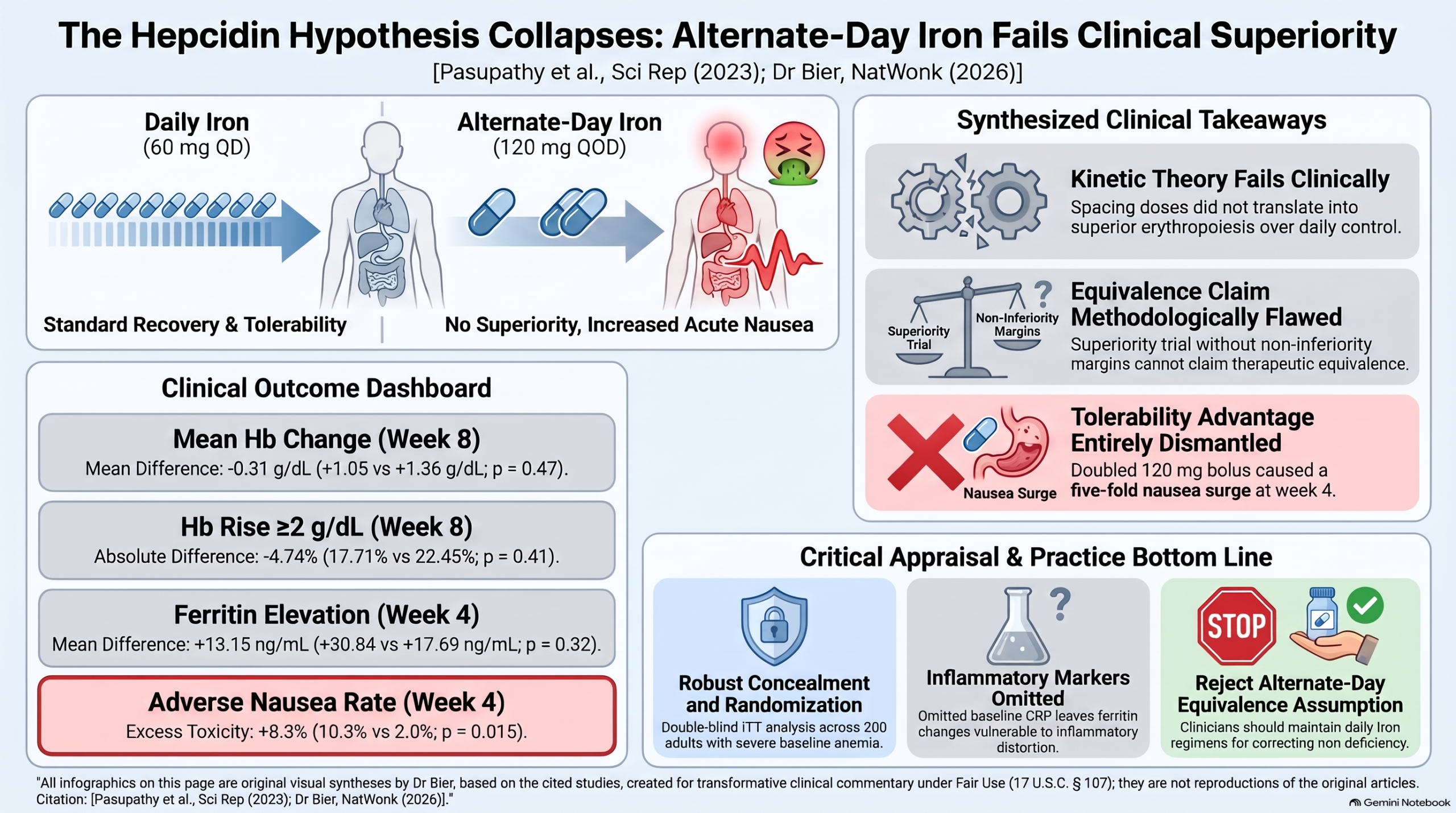
In this randomized trial of 200 adults with significant anemia the hypothesis that alternate-day iron (120 mg elemental iron every other day) would outperform standard daily administration (60 mg daily) flatly failed. Over an 8-week intervention, the mean rise in hemoglobin was +1.05 ± 1.34 g/dL in the alternate-day arm versus +1.36 ± 1.51 g/dL with daily dosing (p = 0.47). Secondary metrics—reticulocyte response, 4-week ferritin repletion, and the proportion hitting a 2 g/dL hemoglobin gain—similarly showed no clear advantage.
Just as critical from a clinical standpoint, alternate-day administration yielded no meaningful advantage regarding gastrointestinal tolerance. Delivering a larger single bolus (120 mg) every other day did not resolve adverse events and actually drove a transient spike in nausea at week 4 (10.3% vs. 2.0%, p = 0.015). In clinical practice, rather than fixating solely on dosing intervals, clinical attention should center on optimizing the absorptive terrain—evaluating potential hypochlorhydria, addressing underlying intestinal health, and as most of us do, utilizing gentler chelated formulations that don’t cause the GI upset that older formulations did.
Alternate day versus daily oral iron for treatment of iron deficiency anemia: a randomized controlled trial
Clinical Bottom Line
This double-blind, active-controlled randomized trial evaluated alternate-day (120 mg elemental iron every other day) versus daily (60 mg elemental iron daily) oral ferrous sulfate over 8 weeks in 200 adults with iron deficiency anemia [Abs, p1] [Meth, p1]. The study failed to demonstrate superiority of alternate-day dosing for the primary endpoint of mean change in hemoglobin from baseline at week 8 (+1.05 ± 1.34 g/dL alternate-day vs. +1.36 ± 1.51 g/dL daily; p = 0.47) [Abs, p1]. While the investigators posited parity between regimens, the trial was explicitly hypothesized and powered as a superiority trial (“test the hypothesis that alternate day oral iron as single dose is superior to daily single dose”) [Intro, p1] and did not pre-specify a non-inferiority margin (Delta), power calculation, or Per-Protocol (PP) analysis set [Meth, p1] [Meth, p3]. Consequently, non-inferiority cannot be methodologically or statistically claimed. Furthermore, alternate-day administration offered no demonstrated tolerability benefit, showing similar overall adverse events and a transient signal for increased nausea at week 4 [Disc, p1]. Clinicians should not interpret the lack of a statistically significant difference as evidence of therapeutic equivalence.
Results in Context
- Key Metric Definitions:
- Mean Difference (MD): The absolute difference between the mean changes observed in two intervention groups.
- p-value: The probability of obtaining test results at least as extreme as the results actually observed, assuming the null hypothesis of no difference is true.
- Primary Endpoint:
- Mean change in hemoglobin from baseline at week 8:
- Alternate-day arm (n = 100): +1.05 ± 1.34 g/dL [Abs, p1] [Res, Table p3_406].
- Daily arm (n = 100): +1.36 ± 1.51 g/dL [Abs, p1] [Res, Table p3_406].
- Between-group comparison: p = 0.47; 95% confidence intervals and formal non-inferiority margin testing were not reported [Abs, p1].
- Baseline hemoglobin levels were 6.53 ± 1.89 g/dL in the alternate-day arm and 6.68 ± 1.89 g/dL in the daily arm [Abs, p1] [Res, Table p3_406].
- Secondary Endpoints & Biomarkers:
- Proportion of participants achieving a hemoglobin rise ≥ 2 g/dL at week 8: Reported as showing no statistically significant differences between groups [Abs, p1] [Meth, p1].
- Change in mean reticulocyte count at 2 weeks: No statistically significant difference between arms [Abs, p1] [Disc, p1].
- Change in mean serum ferritin levels at 4 weeks: No statistically significant difference between arms [Abs, p1] [Disc, p1].
- Safety and Harms:
- Overall adverse events: No major differences were noted between arms across 8 weeks, except for a statistically significant increase in nausea in the alternate-day arm at week 4 [Disc, p1]. Granular event counts, denominators, and risk ratios for specific gastrointestinal events across all timepoints were not provided in the primary text [Meth, p1] [Disc, p1].
Assertive Critical Appraisal
- Absence of Non-Inferiority Framework & Dual Analysis:
The trial protocol framed the research objective around testing whether alternate-day iron was superior to daily iron [Intro, p1]. However, the authors concluded therapeutic equivalence based on a non-significant p-value (p = 0.47) [Abs, p1] [Disc, p5]. In non-inferiority appraisal, concluding parity from a failure to demonstrate superiority commits an “absence of evidence is evidence of absence” fallacy. Crucially, the trial did not pre-specify or report a Per-Protocol (PP) analysis set alongside the Intention-to-Treat (ITT) population [Meth, p1] [Res, FigLegend p3_298]. Non-inferiority claims require dual concordance across both ITT and PP populations to guard against treatment effect dilution.
- Lack of Pre-Specified Delta Margin and Historical Justification:
The manuscript contains no pre-specified clinical or statistical non-inferiority margin (Delta) designed to preserve at least 50% of the active comparator’s established efficacy over placebo. Without an a priori Delta margin and associated 95% confidence intervals bounded within that margin, therapeutic interchangeability cannot be affirmed.
- Strategic Objective and Efficacy-Tolerability Trade-Off:
Alternate-day dosing was hypothesized as a replacement strategy to mitigate gastrointestinal intolerance and improve hepcidin kinetics [Intro, p1]. However, alternate-day dosing demonstrated no compensatory tolerability advantage and was associated with increased nausea at week 4 [Disc, p1]. Accepting potentially lower absolute hemoglobin gains (+1.05 g/dL vs. +1.36 g/dL) without an offsetting reduction in toxicity undermines the rationale for replacement dosing.
- Assay Sensitivity and Constancy Assumption:
Daily oral iron resulted in an average hemoglobin increase of +1.36 g/dL over 8 weeks from a severe baseline anemia of 6.68 g/dL [Abs, p1] [Res, Table p3_406]. This hematologic recovery is modest compared to typical response rates in severe iron deficiency, where rapid rises of 1–2 g/dL within 2 to 4 weeks are standard [Intro, p1]. While external reference trials are discussed [Disc, p2] [Disc, p3] [Disc, p5], formal validation of assay sensitivity and control constancy was not integrated into the statistical design.
- Randomization and Allocation Concealment:
The trial utilized computer-generated block randomization (block size of 4) concealed with sequentially numbered, opaque sealed envelopes handled by an independent clinician [Meth, p1]. Baseline prognostic characteristics (including age, baseline hemoglobin, ferritin, and indices) were balanced between the two 100-patient cohorts [Res, Table p3_406]. Low risk of bias.
- Deviations from Intended Interventions:
Blinding was preserved via a double-dummy design using identical-appearing placebos on alternate days in the active control arm [Meth, p1]. All 200 participants were analyzed according to randomized groups [Abs, p1] [Res, FigLegend p3_298]. Low risk of bias.
- Missing Outcome Data & Attrition:
The CONSORT flow diagram tracked participant progression from screening to follow-up [Res, FigLegend p3_298]. However, the main text does not detail week-8 completion rates, dropouts due to side effects, or explicit sensitivity analyses handling missing outcome data.
- Outcome Measurement:
The primary endpoint (hemoglobin concentration at week 8) and secondary laboratory markers (ferritin, reticulocytes) are objective automated hematologic measures [Meth, p1]. Blinding of participants and investigators further protected against assessment bias [Meth, p1]. Low risk of bias.
- Selective Reporting:
The trial was prospectively registered in the Clinical Trial Registry of India (CTRI/2019/01/017169) [Meth, p2]. While primary and secondary outcomes matched protocol targets, the main text omitted numerical tables for secondary biomarker values (ferritin and reticulocyte counts) and specific adverse event frequencies, providing only qualitative narrative summaries [Disc, p1].
- Harms Reporting Standards:
Adverse events were reported narratively without explicit participant counts, proportions, relative risks, or 95% confidence intervals for each event type across arms [Disc, p1]. Specific zero-event toxicities and complete tabular safety data were omitted from the primary text.
- Survival Analysis Not Applicable:
The study evaluated fixed-interval continuous laboratory outcomes at 2, 4, and 8 weeks rather than time-to-event outcomes; Cox proportional hazards models were not employed [Meth, p1].
Research Objective
To evaluate the efficacy and safety of alternate-day oral iron supplementation (120 mg elemental iron every other day) compared with standard daily oral iron (60 mg elemental iron daily) for improving hemoglobin in patients with iron deficiency anemia [Abs, p1] [Meth, p3].
Study Design
Prospective, parallel-group, double-blind, active-controlled randomized trial [Meth, p3]. Participants received either two ferrous sulfate tablets (total 120 mg elemental iron) on alternate days plus alternate-day matching placebo, or one ferrous sulfate tablet (60 mg elemental iron) daily plus one daily placebo tablet for 8 weeks [Meth, p1]. No non-inferiority margin was pre-specified [Meth, p1] [Meth, p3].
Setting and Participants
- Setting: Outpatient and inpatient units of a tertiary care teaching hospital (Pondicherry Institute of Medical Sciences) in South India between January 2019 and December 2020 [Meth, p3] [Res, FigLegend p3_298].
- Participants: 300 individuals screened, 200 randomized (100 in the alternate-day arm, 100 in the daily arm) [Res, FigLegend p3_298] [Res, Table p3_406].
- Eligibility Criteria: Adults aged 16 years and older with hemoglobin ≤ 10 g/dL and microcytic hypochromic anemia on peripheral smear and/or serum ferritin < 50 ng/mL [Meth, p3].
- Key Exclusion Criteria: Chronic kidney disease, chronic liver disease, heart failure, malignancy, hemolytic anemias/hemoglobinopathies, pregnancy, or recent blood transfusion within 3 months [Meth, p3].
Bibliographic Data
- Title: Alternate day versus daily oral iron for treatment of iron deficiency anemia: a randomized controlled trial [Doc Header]
- Authors: Elamparithi Pasupathy, Ravichandran Kandasamy, Kurien Thomas, Aneesh Basheer [Doc Header]
- Journal: Scientific Reports [Doc Header]
- Year: 2023 [Doc Header]
- DOI / PubMed ID: https://doi.org/10.1038/s41598-023-29034-9 | https://pubmed.ncbi.nlm.nih.gov/36725875 [Doc Header]
Fair Use & Copyright: This post provides a transformative, thesis‑driven critical appraisal intended for educational and scholarly purposes. It is not a reproduction of, nor a market substitute for, the original research article.
Support the Version of Record: To support the copyright holders and verify the underlying data—including primary survival curves, risk estimates, and other core outcomes—readers are strongly encouraged to access the original Version of Record via the link or DOI provided above.
Medical Disclaimer: This content is for informational and educational purposes only and is not a substitute for professional medical advice, diagnosis, or treatment.