
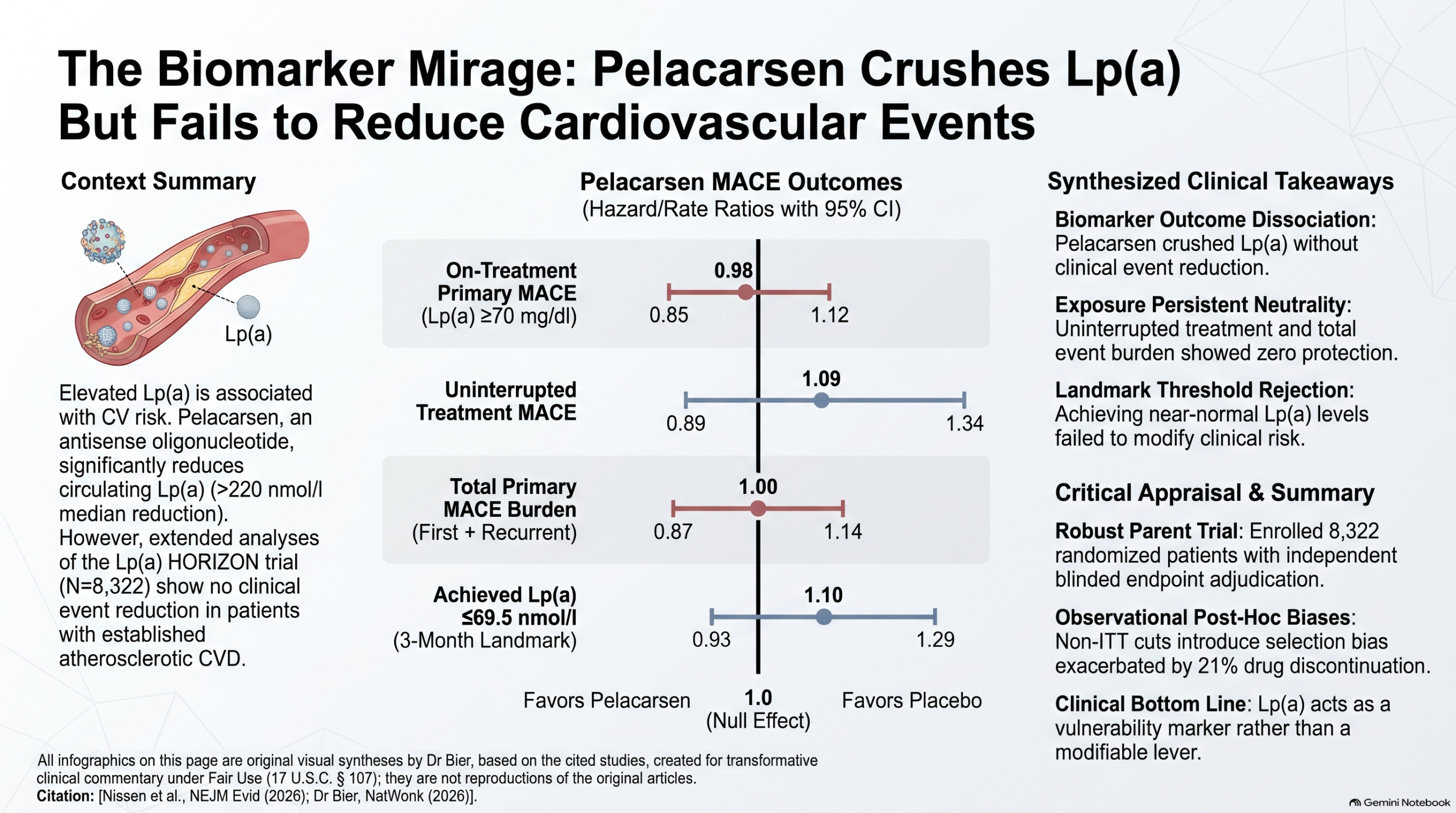
We have a long-standing, reductionist habit in cardiology of mistaking the laboratory requisition for the patient. When epidemiological associations and Mendelian randomization point to a circulating particle like lipoprotein(a) as a culprit, the pharmaceutical impulse is predictable: design an oligonucleotide to crush the biomarker and assume clinical salvation will follow. But human vascular biology does not necessarily linearally follow pharmacological and turning down a biochemical dial does not automatically confer biological resilience.
The extended analyses of the Lp(a) HORIZON trial deliver a stark confrontation with structural reality [Abstract, Para 1]. Pelacarsen fundamentally suppressed its target, driving median reductions of 220 nmol/l in the upper responder half [Results, Table 3]. Yet despite this pharmacodynamic potency, the clinical return was absolute zero. In the on-treatment population, the primary four-component MACE was entirely flat (HR 0.98; 95% CI, 0.85 to 1.12), yielding an absolute risk reduction of a trivial 1.3% that completely failed to achieve statistical significance [Abstract, Para 3] [Results, Table p6_60]. The survival curves simply refused to separate.
To salvage the hypothesis, investigators went looking for a signal across every conceivable exposure cut, but the data only sank deeper into statistical quicksand. Conditioning on uninterrupted exposure actually swung the point estimate in the wrong direction (HR 1.09; 95% CI, 0.89 to 1.34) [Abstract, Para 3]. Tallying total event burden—first and recurrent events alike—yielded an identical rate ratio of 1.00 (95% CI, 0.87 to 1.14) [Abstract, Para 3]. Most damning of all, the landmark analysis revealed that participants who achieved the lowest circulating thresholds (≤69.5 nmol/l) derived zero protection compared to placebo (HR 1.10; 95% CI, 0.93 to 1.29) [Abstract, Para 3]. The surrogate biomarker moved dramatically; the patient’s clinical trajectory did not budge an inch.
What we are witnessing is the collapse of a clean mechanistic narrative when forced to confront hard clinical outcomes. In mature secondary prevention cohorts with established atherothrombotic disease, circulating Lp(a) is predominantly an observational artifact of systemic vulnerability, not an isolated biological lever that can be pharmacologically manipulated to reverse years of endothelial damage. True vascular health requires cultivating systemic metabolic fitness, addressing endothelial glycocalyx integrity, resolving underlying inflammatory drivers, and supporting whole-person physiology—not simply pinning our hopes on a medication that fixes a lab value while leaving the actual disease process entirely untouched.
Extended Analyses of Pelacarsen and Cardiovascular Outcomes in Patients with High Lipoprotein(a)
Clinical Bottom Line
In patients with established atherosclerotic cardiovascular disease and markedly elevated lipoprotein(a) (≥70 mg/dl), extended secondary analyses from the Lp(a) HORIZON trial demonstrated that pelacarsen does not reduce major adverse cardiovascular events (MACE) [Abs, p1] [Abs, p3]. Point estimates remained null across all examined exposure definitions, including on-treatment exposure (HR 0.98; 95% CI, 0.85 to 1.12), uninterrupted treatment (HR 1.09; 95% CI, 0.89 to 1.34), total primary endpoint events (first and recurrent; RR 1.00; 95% CI, 0.87 to 1.14), 3-month achieved Lp(a) levels (HR 1.10; 95% CI, 0.93 to 1.29), and prespecified biomarker strata [Abs, p3].
These extended analyses confirm that the primary null trial result was not an artifact of drug discontinuation, dilution across non-adherent person-time, failure to evaluate recurrent events, or inadequate magnitude of biomarker reduction [Disc, p1] [Disc, p2]. However, clinicians must interpret these post-hoc and exploratory analyses cautiously: breaking the randomized intention-to-treat (ITT) framework via per-protocol and landmark conditioning introduces potential healthy-adherer and selection biases, and multiple testing was unadjusted [Meth, p9] [Disc, p5]. In established secondary prevention populations, therapeutic lowering of Lp(a) via pelacarsen fails to confer cardiovascular benefit [Abs, p1] [Concl, p1].
Results in Context
The primary four-component composite outcome comprised cardiovascular death, nonfatal myocardial infarction, nonfatal stroke, or urgent coronary revascularization [Meth, p3].
On-Treatment and Exposure Analyses
- Full On-Treatment Population (Lp(a) ≥70 mg/dl): A primary endpoint event occurred in 380 of 4,157 patients (9.1%) receiving pelacarsen compared with 434 of 4,165 patients (10.4%) receiving placebo [Res, Table p6_60]. The hazard ratio (HR) was 0.98 (95% CI, 0.85 to 1.12) [Res, Table p6_60]. The absolute risk reduction (ARR) was 1.3% (95% CI, -0.01% to 2.61%), yielding a nominal Number Needed to Treat (NNT) of approximately 77 over the trial period; however, this difference was not statistically significant.
- Severe Elevation Subpopulation (Lp(a) ≥90 mg/dl): Primary endpoint events occurred in 296 of 3,266 patients (9.1%) in the pelacarsen group and 345 of 3,274 patients (10.5%) in the placebo group (HR 0.96; 95% CI, 0.82 to 1.12) [Res, Table p6_60].
- Uninterrupted Treatment Population: Among patients completing therapy without an interruption >60 days (n = 3,539), primary events occurred in 167 of 1,514 patients (11.0%) on pelacarsen versus 204 of 2,025 patients (10.1%) on placebo (HR 1.09; 95% CI, 0.89 to 1.34) [Abs, p3] [Res, Table p6_60].
Secondary Composite Endpoints
- Three-Component MACE (CV Death, Nonfatal MI, Nonfatal Stroke):
- Full population (≥70 mg/dl): 312 of 4,157 (7.5%) on pelacarsen vs. 355 of 4,165 (8.5%) on placebo (HR 0.98; 95% CI, 0.85 to 1.15) [Res, Table p6_60].
- Subpopulation (≥90 mg/dl): 239 of 3,266 (7.3%) on pelacarsen vs. 281 of 3,274 (8.6%) on placebo (HR 0.96; 95% CI, 0.80 to 1.14) [Res, Table p6_60].
- Three-Component MACE substituting CHD Death and Excluding Stroke:
- Full population (≥70 mg/dl): 289 of 4,157 (7.0%) on pelacarsen vs. 351 of 4,165 (8.4%) on placebo (HR 0.92; 95% CI, 0.79 to 1.07) [Res, Table p6_60].
- Subpopulation (≥90 mg/dl): 230 of 3,266 (7.0%) on pelacarsen vs. 275 of 3,274 (8.4%) on placebo (HR 0.93; 95% CI, 0.78 to 1.11) [Res, Table p6_60].
Total Recurrent Events and Landmark Analyses
- Total Primary MACE Burden (First + Recurrent): Evaluated via the Lin-Wei-Yang-Ying method, there were 644 total events in the pelacarsen arm vs. 646 in the placebo arm (Rate Ratio [RR] 1.00; 95% CI, 0.87 to 1.14) [Abs, p3] [Meth, p7] [Res, Table p6_60]. In the ≥90 mg/dl subpopulation, total events were 504 vs. 508 (RR 1.00; 95% CI, 0.86 to 1.16) [Res, Table p6_60].
- 3-Month Landmark Analysis (Conditioned on Survival and Event-Free Status at Month 3):
- Absolute Lp(a) reduction ≥170 nmol/l (median): Adjusted HR 1.09 (95% CI, 0.92 to 1.29) vs. placebo [Abs, p3] [Res, Table 3].
- Absolute Lp(a) reduction <170 nmol/l: Adjusted HR 1.03 (95% CI, 0.87 to 1.23) vs. placebo [Res, Table 3].
- Achieved Lp(a) ≤69.5 nmol/l (median): Adjusted HR 1.10 (95% CI, 0.93 to 1.29) vs. placebo [Abs, p3] [Res, Table 3].
- Achieved Lp(a) >69.5 nmol/l: Adjusted HR 1.03 (95% CI, 0.87 to 1.22) vs. placebo [Res, Table 3].
Adverse Events and Safety Profile
The primary Lp(a) HORIZON parent trial safety disclosures are referenced, but this extended report omits detailed tabular adverse event breakdowns. It discloses that tolerability issues caused treatment discontinuation in 21% of pelacarsen-assigned participants [Disc, p2]. Specific counts of mild, moderate, or severe treatment-emergent adverse events, injection-site reactions, or thrombocytopenia are not itemized in this paper.
Metric Definitions
- Hazard Ratio (HR): The ratio of the hazard rates corresponding to the conditions described by two levels of an explanatory variable; values near 1.00 signify equal instantaneous risk over time.
- Rate Ratio (RR): A ratio comparing event rates (taking recurrent events and overall exposure time into account) between treatment groups.
- Absolute Risk Reduction (ARR): The absolute arithmetic difference in event rates between two comparison groups.
- Number Needed to Treat (NNT): The reciprocal of the ARR (1 / ARR), indicating the average number of patients who must receive an intervention to prevent one additional adverse outcome.
Assertive Critical Appraisal
- Overall Cochrane RoB 2 Judgment: High risk of bias for the specific causal questions addressed in this secondary manuscript. While the parent trial Lp(a) HORIZON was a randomized, double-blind trial [Meth, p1], the current report focuses primarily on observational, non-randomized subsets (on-treatment, uninterrupted treatment, and post-randomization responder landmark cohorts) [Meth, p5] [Meth, p8] [Res, Table p6_60].
- Domain 1: Randomization Process: Low risk in the parent study; centralized randomization preserved baseline prognostic balance between arms (mean age 62.4 ± 10.1 vs 61.8 ± 10.2 years; diabetes 34.4% vs 37.8%) [Res, Table p5_60]. However, for the uninterrupted treatment cohort (n = 1,514 pelacarsen vs n = 2,025 placebo), baseline prognostic exchangeability was severed by differential adherence and dropout [Res, Table p6_60] [Disc, p2].
- Domain 2: Deviations from Intended Interventions: High risk. The primary efficacy analyses presented here are on-treatment and per-protocol cohorts rather than strict Intention-to-Treat [Abs, p2] [Meth, p5]. A substantial proportion of patients discontinued drug (21% on pelacarsen), and evaluating only uninterrupted or adherent patients introduces strong healthy-user and adherence confounding [Disc, p2].
- Domain 3: Missing Outcome Data: Low risk. Vital status and primary clinical endpoints were complete with no missing outcome events [Meth, p10]. Missing baseline covariates for models were minimal (LDL n = 1, Lp(a) n = 34, BMI n = 5) and handled via median imputation [Meth, p9]. Nonadministrative censoring was balanced (pelacarsen 122 vs placebo 109) [Meth, p14].
- Domain 4: Measurement of the Outcome: Low risk. Outcomes were adjudicated by an independent Clinical Endpoints Committee (C5Research) blinded to randomized assignment and biomarker values [Meth, p3] [Meth, p4].
- Domain 5: Selection of Reported Results: Some concerns. Although analyses were prespecified prior to unblinding and database lock [Meth, p1], the authors explicitly acknowledge that these secondary investigations were not multiplicity-controlled, requiring them to be viewed as hypothesis-generating [Disc, p5].
- Composite Endpoint Deconstruction: The primary composite pooled hard endpoints (cardiovascular death, nonfatal stroke, nonfatal MI) with soft endpoints (urgent coronary revascularization) [Meth, p3]. Separate reporting showed consistency: three-component MACE excluding revascularization remained neutral (HR 0.98; 95% CI, 0.85 to 1.15) [Res, Table p6_60].
- Surrogate vs. Hard Clinical Outcome Dissociation: A profound dissociation was documented. Substantial pharmacodynamic reduction of Lp(a) (median absolute reduction ≥170 nmol/l, achieved levels ≤69.5 nmol/l) yielded no clinical risk reduction in MACE (HR 1.09; 95% CI, 0.92 to 1.29) [Abs, p3] [Res, Table 3].
- Proportional Hazards Assumption: Formally evaluated using Schoenfeld global tests and reported as fully met (all global p > 0.05) [Meth, p16].
- Subgroup and Interaction Testing: Subgroups stratified by baseline Lp(a), LDL-C, hsCRP, and time from qualifying event demonstrated no interaction or differential efficacy, confirming robust null results across clinical subsets [Meth, p10] [Res, Table 4].
- Immortal Time Bias: Landmark analyses appropriately restricted the cohort to participants alive, event-free, and assessed at 3 months post-randomization, eliminating immortal time prior to landmark assessment [Meth, p8].
- Safety and Harms Reporting: Significant deficiency in safety reporting. Specific adverse event incidences, relative harms, and zero-event disclosures were not provided in this report, relying solely on broad citations to the primary trial publication [Intro, p1] [Disc, p2].
Research Objective
To investigate whether the neutral clinical effect of pelacarsen on major adverse cardiovascular events in the Lp(a) HORIZON trial was attributable to treatment exposure heterogeneity, failure to capture total recurrent events, insufficient biomarker reduction, baseline risk differences, or disease chronicity [Abs, p1] [Intro, p1].
Study Design
Extended, prespecified secondary and landmark analyses of an international, multicenter, randomized, double-blind, placebo-controlled clinical trial (Lp(a) HORIZON) [Meth, p1]. Primary comparisons evaluated on-treatment exposure, uninterrupted treatment cohorts (no interruption >60 days), recurrent event models (Lin-Wei-Yang-Ying method), and 3-month landmark Cox proportional hazards models adjusted for baseline cardiovascular risk factors [Meth, p5] [Meth, p7] [Meth, p8] [Meth, p9]. Adjudication of cardiovascular events was conducted by a blinded central clinical endpoints committee [Meth, p3] [Meth, p4].
Setting and Participants
- Setting: 797 clinical sites across 42 countries [Meth, p1].
- Sample Size: 8,322 randomized patients (4,157 pelacarsen, 4,165 placebo) [Meth, p1] [Res, Table p6_60]; 3,539 evaluated in the uninterrupted treatment cohort [Res, p17] [Res, Table p6_60]; 7,509 evaluated in the 3-month landmark cohort [Res, p3].
- Inclusion Criteria: Adults aged 18 to 80 years with established atherosclerotic cardiovascular disease (prior myocardial infarction, ischemic stroke, or symptomatic peripheral arterial disease occurring >3 months and <10 years before enrollment) and screening serum lipoprotein(a) levels ≥70 mg/dl [Meth, p3].
- Exclusion Criteria / Analyzed Subsets: Patients experiencing events or death prior to month 3 were excluded from landmark analyses [Meth, p8]; nonadministrative dropouts included consent withdrawal and protocol deviations [Meth, Fig 1].
Bibliographic Data
- Title: Extended Analyses of Pelacarsen and Cardiovascular Outcomes in Patients with High Lipoprotein(a) Header
- Authors: Steven E. Nissen, M.D., Leslie Cho, M.D., Seth Frndak, Ph.D., Kathy Wolski, M.P.H., Jing Wang, Ph.D., Brian Manning, Pharm.D., Eran Leitersdorf, M.D., Ulf Landmesser, M.D., Jackie McCluskey, R.N., Michael J. Blaha, M.D., A. Michael Lincoff, M.D., Ziqiang Zhao, Ph.D., Bjorn Mueller-Edenborn, M.D., Thomas G. Nuehrenberg, M.D., Sotirios Tsimikas, M.D. Header
- Journal: NEJM Evidence Header
- Year: 2026 Header
- DOI / PubMed ID: https://doi.org/10.1056/EVIDoa2600373 Header
Fair Use & Copyright: This post provides a transformative, thesis‑driven critical appraisal intended for educational and scholarly purposes. It is not a reproduction of, nor a market substitute for, the original research article.
Support the Version of Record: To support the copyright holders and verify the underlying data—including primary survival curves, risk estimates, and other core outcomes—readers are strongly encouraged to access the original Version of Record via the link or DOI provided above.
Medical Disclaimer: This content is for informational and educational purposes only and is not a substitute for professional medical advice, diagnosis, or treatment.