
Comment:
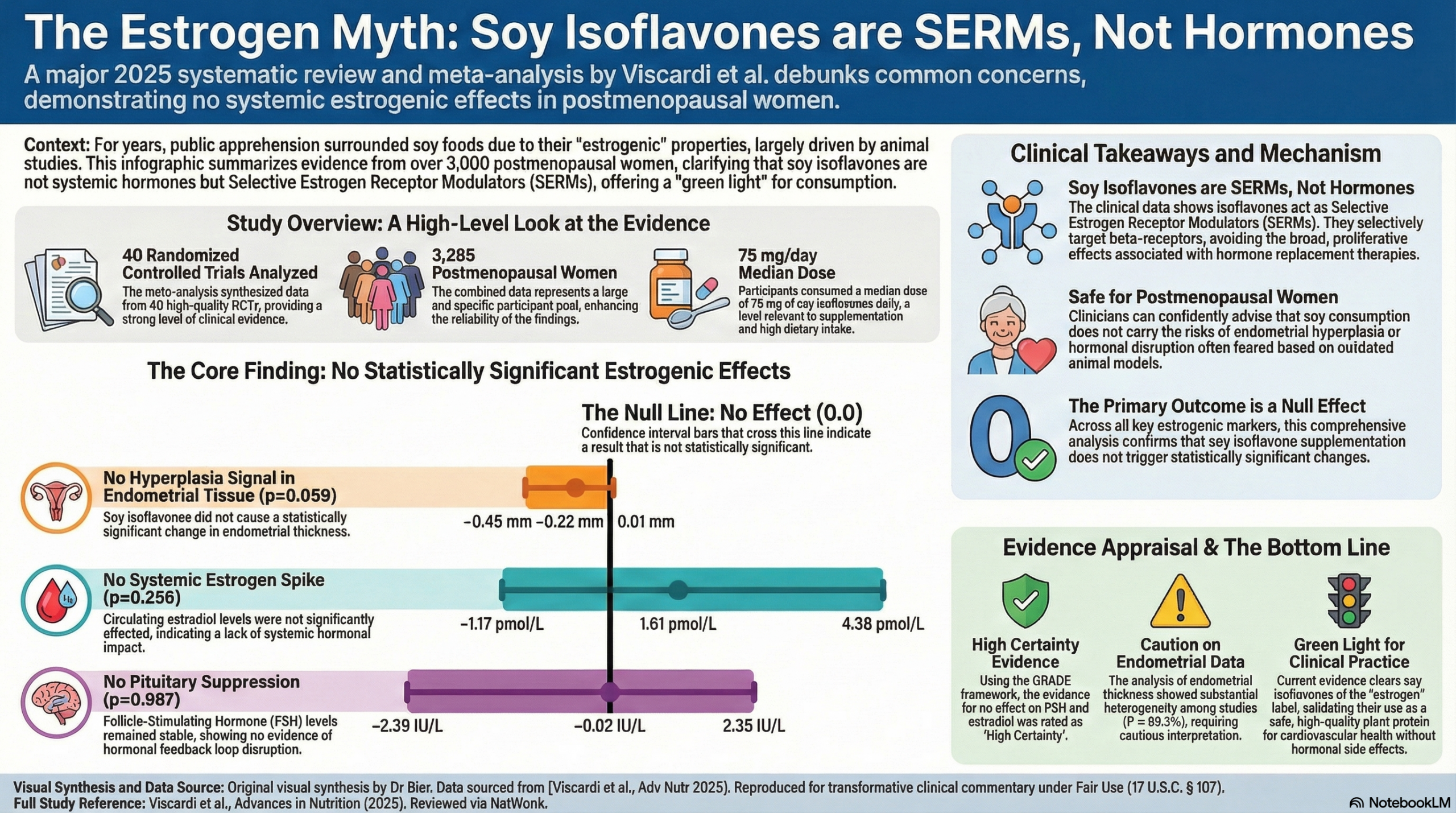
This systematic review and meta-analysis is yet another high-level confirmation of a reality seen across decades of human clinical data: soy isoflavones do not possess the systemic estrogenic risks often attributed to them. In the hierarchy of research, human RCTs carry the most weight, and the aggregation of 42 randomized controlled trials here should effectively put the “estrogen myth” of soy to rest.
The nice things about this trials is the data on very specific outcome measures of hormonal influence on the female system. The data—representing over 3,000 women—shows no statistically significant impact on endometrial thickness, vaginal maturation or hormone levels, even at median doses of 75 mg/d. The actual clinical utility of these results is that soy functions as a Selective Estrogen Receptor Modulator (SERM) rather than a hormone. This reinforces the priority of human clinical outcomes over theoretical biochemical mechanisms or animal models as animals metabolize the isoflavones in soy differently than humans do. This, provided a clear green light for clinicians to utilize these components without fear of inducing hyperplasia or hormonal disruption.
The Wonk Debate – Audio Critique & Clinical Commentary:
Summary:
Clinical Bottom Line
This systematic review and meta-analysis demonstrates that soy isoflavone consumption does not exert statistically significant estrogenic effects on endometrial thickness, vaginal maturation index (VMI), or circulating hormone levels (FSH, estradiol) in postmenopausal women. The certainty of this evidence ranges from moderate to high. These findings support the hypothesis that soy isoflavones likely function as Selective Estrogen Receptor Modulators (SERMs)—binding preferentially to estrogen receptor-beta rather than alpha—thereby differing clinically from the hormone estrogen. For clinicians, this alleviates specific safety concerns regarding the potential for soy to induce hyperplasia in the endometrium or alter systemic hormonal profiles in postmenopausal women.
Results
- Summary of Results: The analysis included 40 randomized controlled trials (52 comparisons) with 3,285 postmenopausal women, investigating a median reported dose of 75 mg/d of soy isoflavones over a median duration of 24 weeks.
- Endometrial Thickness (ET): There was no significant difference between groups (Mean Difference -0.22 mm; 95% CI -0.45 to 0.01 mm; P=0.059).
- Vaginal Maturation Index (VMI): There was no significant difference between groups (Mean Difference 2.31; 95% CI -2.14 to 6.75; P=0.310).
- Follicle-Stimulating Hormone (FSH): There was no significant difference between groups (Mean Difference -0.02 IU/L; 95% CI -2.39 to 2.35 IU/L; P=0.987).
- Estradiol: There was no significant difference between groups (Mean Difference 1.61 pmol/L; 95% CI -1.17 to 4.38 pmol/L; P=0.256).
- Definitions: The Mean Difference (MD) represents the absolute difference in the measured values between the treatment and control groups. A 95% Confidence Interval (CI) that crosses zero (e.g., -0.45 to 0.01) indicates that the result is not statistically significant.
Assertive Critical Appraisal
- Certainty of Evidence (GRADE Framework):
- The authors rated the certainty of evidence as High for FSH and estradiol, indicating strong confidence that the true effect lies close to the estimate.
- The certainty was rated as Moderate for Endometrial Thickness (due to inconsistency/heterogeneity) and VMI (due to imprecision, i.e., wide confidence intervals).
- Heterogeneity:
- Endometrial Thickness: The I2 was 69.3%, indicating substantial heterogeneity. This means there was significant variation in results across studies that could not be explained by chance alone. Sensitivity analyses suggested specific trials contributed to this, but the direction of effect remained consistent.
- FSH: The I2 was 51.9%, also indicating substantial heterogeneity.
- VMI and Estradiol: The I2 values were low (1.3% and 23.5%, respectively), suggesting consistent results across these trials.
- Publication Bias: The authors assessed for publication bias using contour-enhanced funnel plots and formal statistical tests (Egger’s and Begg’s) for outcomes with ≥10 trials. They reported no evidence of funnel plot asymmetry for any outcome, suggesting that the suppression of negative studies is unlikely to be skewing these results.
- Risk of Bias in Included Studies: The Cochrane Risk of Bias 2.0 tool was used. While randomization and measurement domains were generally low risk, there were “some concerns” regarding deviations from intended interventions in 35-42% of trials. Overall, the majority of trials were judged to be of low risk or some concerns, with a minority (19-38%) classified as high risk.
- Reporting Quality Assessment (PRISMA): The review demonstrates high reporting quality. It explicitly follows PRISMA-Equity guidelines , the protocol was pre-registered on PROSPERO (CRD42023439239), and a clear flow diagram (Figure 1) documents the exclusion process.
Research Objective
The objective was to determine the effect of soy isoflavones on four specific measures of estrogenicity—endometrial thickness (ET), vaginal maturation index (VMI), follicle-stimulating hormone (FSH), and estradiol—in postmenopausal women compared with non-isoflavone controls.
Study Design
- Search Strategy: A systematic search of MEDLINE, Embase, and the Cochrane Library was conducted through August 2024.
- Selection Criteria: Randomized controlled trials (RCTs) with an intervention period of ≥3 months involving postmenopausal women were included.
- Analysis: Data were analyzed using the generic inverse variance method with a random-effects model (DerSimonian and Laird).
Setting and Participants
- Participants: The analysis included 40 trials representing 52 trial comparisons and a total of 3,285 postmenopausal women.
- Demographics: Participants were predominantly middle-aged (median age 54–55 years) and generally healthy (without chronic disease diagnoses).
- Locations: Most trials were conducted in North America, Europe, and South America.
Bibliographic Data
- Authors: Viscardi G, Back S, Ahmed A, et al.
- Title: Effect of Soy Isoflavones on Measures of Estrogenicity: A Systematic Review and Meta-Analysis of Randomized Controlled Trials
- Journal: Advances in Nutrition
- Year: 2025
- DOI: https://doi.org/10.1016/j.advnut.2024.100327
Original Article:
Full text: PubMed Central
Fair Use & Copyright: This post provides a transformative, thesis‑driven critical appraisal intended for educational and scholarly purposes. It is not a reproduction of, nor a market substitute for, the original research article.
Support the Version of Record: To support the copyright holders and verify the underlying data—including primary survival curves, risk estimates, and other core outcomes—readers are strongly encouraged to access the original Version of Record via the link or DOI provided above.
Medical Disclaimer: This content is for informational and educational purposes only and is not a substitute for professional medical advice, diagnosis, or treatment.