
Comment:
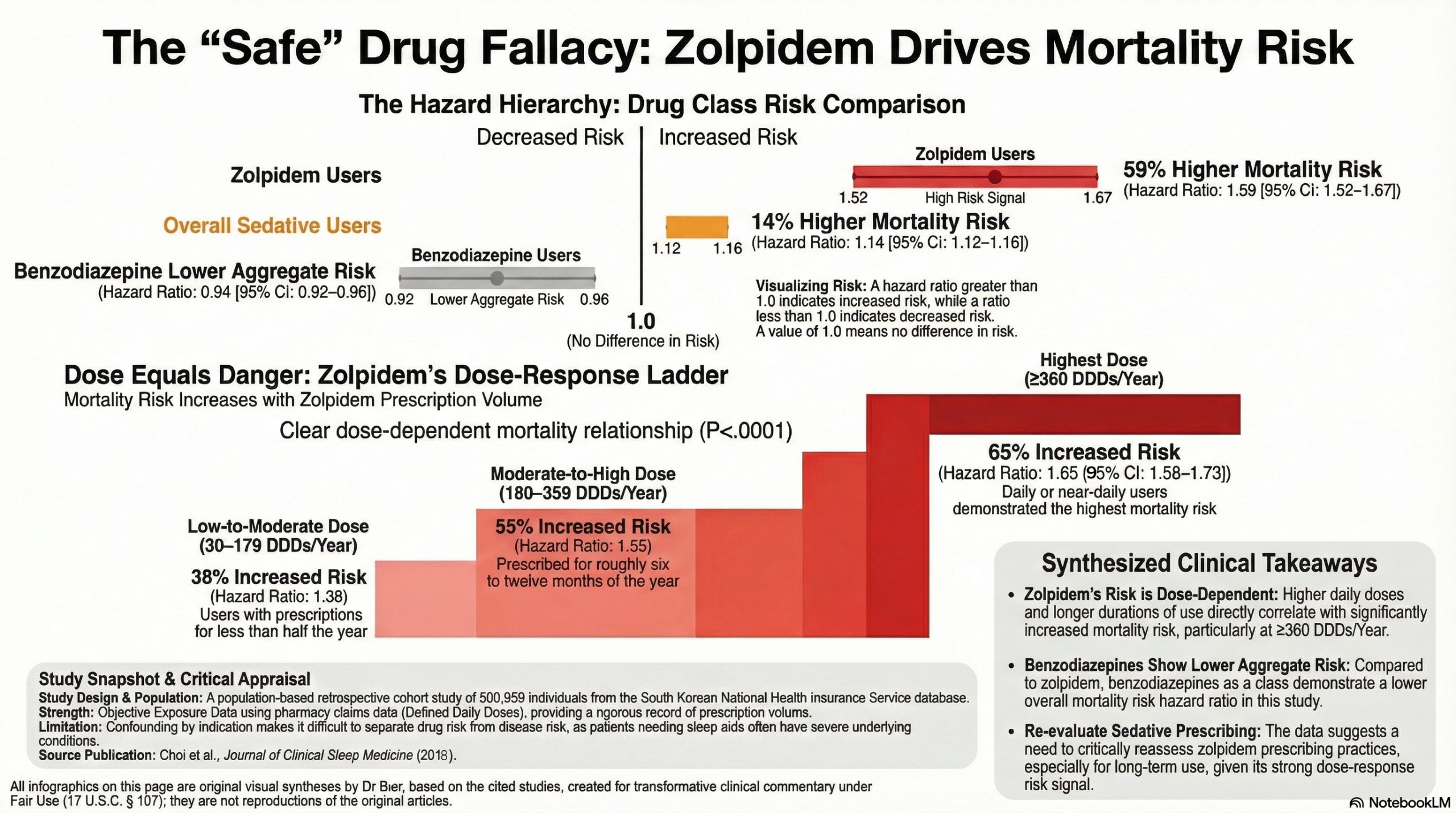
A central discrepancy revealed in this research is the failure of Z-drugs, or specifically zolpidem, to deliver on their promise of clinical safety. Despite conventional wisdom suggesting they are a safer class, the data confirms that sedative-hypnotic users as a whole faced a significantly higher mortality risk than non-users. This human clinical data provides the necessary power to see the hazards that smaller, underpowered studies missed, reinforcing the paradigm that we must always prioritize hard endpoints.
The tangible significance for the aging patient is that the survival cost of habitual zolpidem and likely all sleep meds use likely outweighs the temporary relief provided by pharmacologically induced sleep. While the study is susceptible to confounding by indication, the strength of the association (HR 1.14 overall; HR 1.59 for zolpidem) provides a clear directive for clinical caution. This is yet another place where naturopathic interventions can shine, improving sleep without the associated risks.
The Wonk Debate – Audio Critique & Clinical Commentary:
Summary:
Clinical Bottom Line:
This large-scale retrospective cohort study provides evidence of a significant association between the use of sedative-hypnotic medications and an increased risk of all-cause mortality, with a particularly pronounced risk linked to zolpidem use. While the study identifies a clear dose-dependent relationship, it is critical to emphasize that as an observational analysis, it can identify strong associations but cannot definitively prove that sleep medications cause death. The findings are susceptible to “confounding by indication,” where the underlying reasons for prescribing these medications (such as severe insomnia or other comorbidities) may themselves contribute to the increased risk of mortality.
Results in Context
Main Results:
- Overall Mortality Risk: Participants using sedative-hypnotics (n=180,823) had a significantly higher risk of death compared to nonusers (n=320,136), with an adjusted Hazard Ratio (HR) of 1.14 (95% CI 1.12–1.16).
- Zolpidem-Specific Risk: Users of zolpidem faced a markedly higher mortality risk, with an HR of 1.59 (95% CI 1.52–1.67) compared to nonusers.
- Dose-Response Effect: The study observed a clear dose-dependent relationship, where individuals prescribed 30 or more defined daily doses (DDDs) per year had a significantly higher risk of mortality.
Definitions:
- Hazard Ratio (HR): A measure of how often a particular event (in this case, death) happens in one group compared to another over a specific time period. An HR of 1.59 indicates that the risk of death was 59% higher in the zolpidem group than in the control group.
- 95% Confidence Interval (CI): This range indicates the precision of the estimate; there is a 95% probability that the true risk falls within this interval. Because the CI for zolpidem (1.52–1.67) does not include 1.0, the result is statistically significant.
Participants:
The analysis included a total of 500,959 individuals aged 40 years and older, identified from a 5% random sample of the South Korean National Health Insurance Service database.
Assertive Critical Appraisal
Limitations & Bias (STROBE Framework):
The most significant limitation is the potential for unmeasured confounding. Although the researchers adjusted for age, sex, and comorbidities using the Charlson Comorbidity Index, they could not account for lifestyle factors (e.g., smoking, body mass index) or the specific severity of the underlying sleep disorders, which are independent risk factors for mortality.
Reporting Quality Assessment (STROBE):
The study’s reporting quality is high regarding its efforts to address confounding. The authors explicitly describe the use of a time-dependent Cox regression model to adjust for known variables, which is a critical methodological step in observational research to ensure that the estimated associations are as accurate as possible.
Reporting Quality Assessment (RECORD) for RWE Studies:
As a study using Routinely Collected Health Data (Real-World Evidence), it largely fulfills RECORD principles by clearly identifying the data source (NHIS database) and defining the participant selection process (a 5% random sample). However, the paper would have been strengthened by a more detailed description of the validation of the diagnostic codes and algorithms used to define psychiatric and physical comorbidities from the administrative data.
Applicability:
These findings are highly relevant to clinical practice, particularly in managing older adults (40+) where sedative-hypnotic use is prevalent. The strong association found with zolpidem suggests that clinicians should exercise heightened caution when prescribing Z-drugs and prioritize non-pharmacological interventions like Cognitive Behavioral Therapy for Insomnia (CBT-I).
Research Objective:
To investigate the association between the use of sedative-hypnotics and all-cause mortality using a large-scale, population-based database in the Republic of Korea.
Study Design:
A population-based retrospective cohort study utilizing time-dependent variables to estimate mortality risk over an 11-year follow-up period.
Setting and Participants:
- Setting: National Health Insurance Service (NHIS) database, South Korea, covering data from 2002 to 2015.
- Participants: 500,959 individuals aged 40 years and older; “users” were defined as those prescribed 30 or more DDDs of sedative-hypnotics per year since 2004.
Bibliographic Data:
- Title: Use of sedative-hypnotics and mortality: a population-based retrospective cohort study
- Authors: Jae-Won Choi, Joonki Lee, Sun Jae Jung, Aesun Shin, Yu Jin Lee
- Journal: Journal of Clinical Sleep Medicine
- Year: 2018
- DOI: 10.5664/jcsm.7370
Fair Use & Copyright: This post provides a transformative, thesis‑driven critical appraisal intended for educational and scholarly purposes. It is not a reproduction of, nor a market substitute for, the original research article.
Support the Version of Record: To support the copyright holders and verify the underlying data—including primary survival curves, risk estimates, and other core outcomes—readers are strongly encouraged to access the original Version of Record via the link or DOI provided above.
Medical Disclaimer: This content is for informational and educational purposes only and is not a substitute for professional medical advice, diagnosis, or treatment.