
Comment:
While the finding that current MHT use is associated with concerning neuroimaging markers (accelerated Brain Age Gap, smaller hippocampus) compared to never-users warrants attention, there’s another important aspect – the lack of a statistically significant difference between specific formulations—namely oral versus non-oral (topical/vaginal) administration and estrogen-only versus combined HRT. It is becoming commonly accepted that all the negative impacts of HRT are based on oral formulations, and that may not be the case.
However we must be cautious in interpreting this null result. The study itself highlights that the detailed prescription analysis was limited to a small subsample (N=538), leading to a high probability of being underpowered to detect subtle, yet clinically meaningful, differences. “No evidence of difference” isn’t necessarily definitive.
The fact that the uncorrected data showed negative trends for oral users (higher White Matter Hyperintensity volumes) aligns with the biologically plausible “First Pass Effect” hypothesis, but again, disappears when statistically corrected.
The Wonk Debate – Audio Critique & Clinical Commentary:
Summary:
Clinical Bottom Line
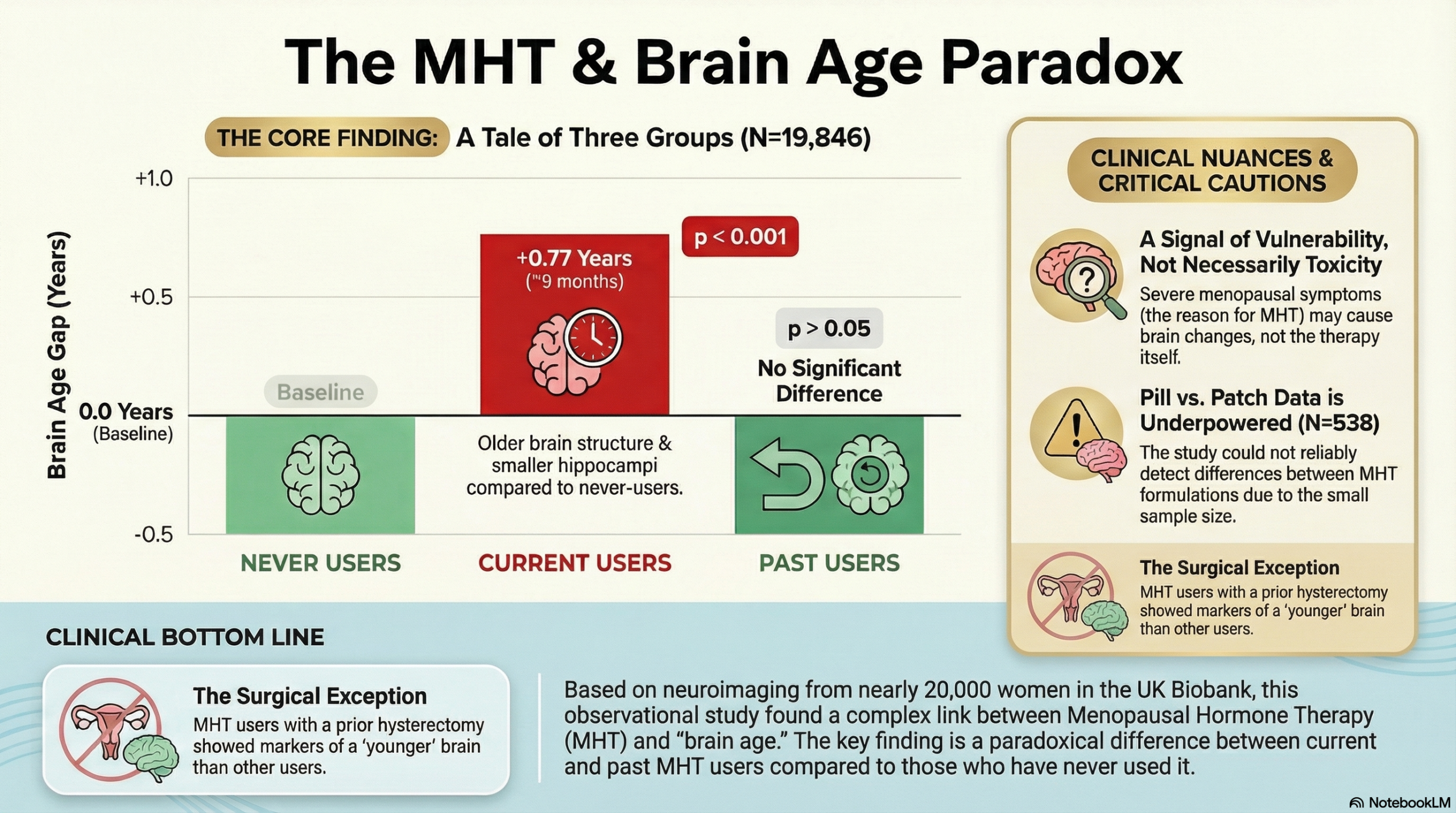
This large observational study suggests that current use of Menopausal Hormone Therapy (MHT) is associated with markers of an “older” brain (increased Brain Age Gap) and smaller hippocampal volumes compared to never-users. Importantly, past users did not show these adverse brain characteristics, suggesting potential reversibility or a selection bias in current users.
Regarding the specific risks of formulations (oral vs. topical) and composition (estrogen-only vs. combined): While the study attempted to differentiate these, it found no statistically significant differences between administration routes or drug types after correcting for multiple comparisons. However, uncorrected data hinted that oral administration and combined formulations might be associated with poorer white matter health, though this remains distinct from high-certainty evidence.
Results in Context
Main Results (Whole Sample, N=19,846)
- Current MHT Users: Exhibited a significantly higher Gray Matter Brain Age Gap (GM BAG) and smaller hippocampal volumes compared to never-users.
- Definition: A positive “Brain Age Gap” indicates the brain looks older on MRI than the patient’s chronological age.
- Magnitude: The difference was up to 0.77 years (approx. 9 months) of accelerated brain aging.
- Past MHT Users: Showed no significant difference in brain age or hippocampal volume compared to never-users.
- Duration Effects: Longer duration of use and older age at last use were associated with higher brain age and greater White Matter Hyperintensity (WMH) volume.
Subgroup Results: Surgical History
- MHT users with a history of hysterectomy (with or without oophorectomy) displayed a younger gray matter brain age compared to MHT users without such surgery.
Detailed Prescription Analysis (Subsample, N=538)
- Oral vs. Non-Oral: After statistical correction, there were no significant associations between the route of administration (oral, transdermal, vaginal) and brain measures.
- Estrogen-only vs. Combined (HRT): Similarly, no significant differences were found between estrogen-only and combined estrogen+progestin formulations after correction.
Assertive Critical Appraisal
Limitations & Bias (STROBE Framework)
- Confounding by Indication (Reverse Causality): The association between current use and poorer brain health may be driven by the fact that women with more severe menopausal symptoms (who are more likely to be prescribed MHT) may already be experiencing neurological changes. The need for MHT might be a marker for neurological vulnerability rather than the cause of it.
- Power Issues in Formulation Analysis: The user asked for discrimination between oral and topical/vaginal formulations. It is critical to note that the detailed prescription analysis was limited to only 538 women. This subsample was likely underpowered to detect subtle differences between formulations. The lack of statistical significance here should not be interpreted as definitive proof of “no difference,” but rather “no evidence of difference” in this specific sample.
- Uncorrected Signals: While not statistically robust, the uncorrected data showed that oral users had higher white matter hyperintensity volumes, and users of combined MHT (specifically CEE + MPA) had higher white matter brain age. These trends align with the “First Pass Effect” hypothesis (oral estrogens producing higher estrone levels via hepatic metabolism), but this study cannot confirm it.
Reporting Quality Assessment (STROBE)
- The study adequately utilized rigorous imaging protocols (using the UK Biobank pipeline) and adjusted for key covariates like BMI, education, and lifestyle.
- However, the comparison groups were unbalanced; current users were significantly younger (mean 60.1 years) than past users (67.5 years) and never users (61.6 years). While age was a covariate, these distinct life stages introduce complexity in interpretation.
Applicability
These findings are applicable to post-menopausal women similar to the UK Biobank cohort (predominantly white, generally healthier than the average population). The results support the complexity of MHT prescribing but do not provide sufficient evidence to strictly recommend one route of administration over another based solely on neuroimaging data.
Research Objective
To investigate the associations between Menopausal Hormone Therapy (MHT) use—including specific formulations, routes of administration, and duration—and brain characteristics (brain age, hippocampal volume, white matter hyperintensities).
Study Design
- Design: Population-based observational cohort study (Cross-sectional analysis).
- Data Source: UK Biobank (neuroimaging and primary care prescription data).
- Analysis: Linear regression models adjusted for age, education, lifestyle, BMI, and menopausal status.
Setting and Participants
- Participants: 19,846 females with MRI data.
- Detailed Subsample: 538 females with detailed primary care prescription records allowing for analysis of specific drug types.
- Key Characteristics: 96.6% White ethnic background.
Bibliographic Data
- Title: Menopausal hormone therapy and the female brain: Leveraging neuroimaging and prescription registry data from the UK Biobank cohort
- Authors: Barth C, Galea LAM, Jacobs EG, Lee BH, Westlye LT, de Lange AMG
- Journal: eLife
- Year: 2024 (Preprint/Review), Version of Record 2025
- DOI: https://doi.org/10.7554/eLife.99538
Original Article:
Full text: PubMed Central
Fair Use & Copyright: This post provides a transformative, thesis‑driven critical appraisal intended for educational and scholarly purposes. It is not a reproduction of, nor a market substitute for, the original research article.
Support the Version of Record: To support the copyright holders and verify the underlying data—including primary survival curves, risk estimates, and other core outcomes—readers are strongly encouraged to access the original Version of Record via the link or DOI provided above.
Medical Disclaimer: This content is for informational and educational purposes only and is not a substitute for professional medical advice, diagnosis, or treatment.