
Comment:
This study is a potential critical piece of the puzzle because it bridges the gap between clinical observation and biological causality. We have known for some time from major clinical trials that statin therapy is associated with a slightly increased risk of developing type 2 diabetes. However, a lingering question has always been whether this was a toxic effect of the drug molecule itself or a fundamental metabolic consequence of lowering LDL cholesterol via specific pathways.
These genetic data argue strongly for the latter. It is not just about the drugs; it is about the biology of low LDL. This aligns with a growing body of observational research showing an inverse relationship between cholesterol and diabetes: individuals with naturally low LDL levels often display a higher prevalence of diabetes, while those with Familial Hypercholesterolemia (lifelong high LDL) appear to be somewhat protected against it.
The Wonk Debate – Audio Critique & Clinical Commentary:
Summary:
Clinical Bottom Line
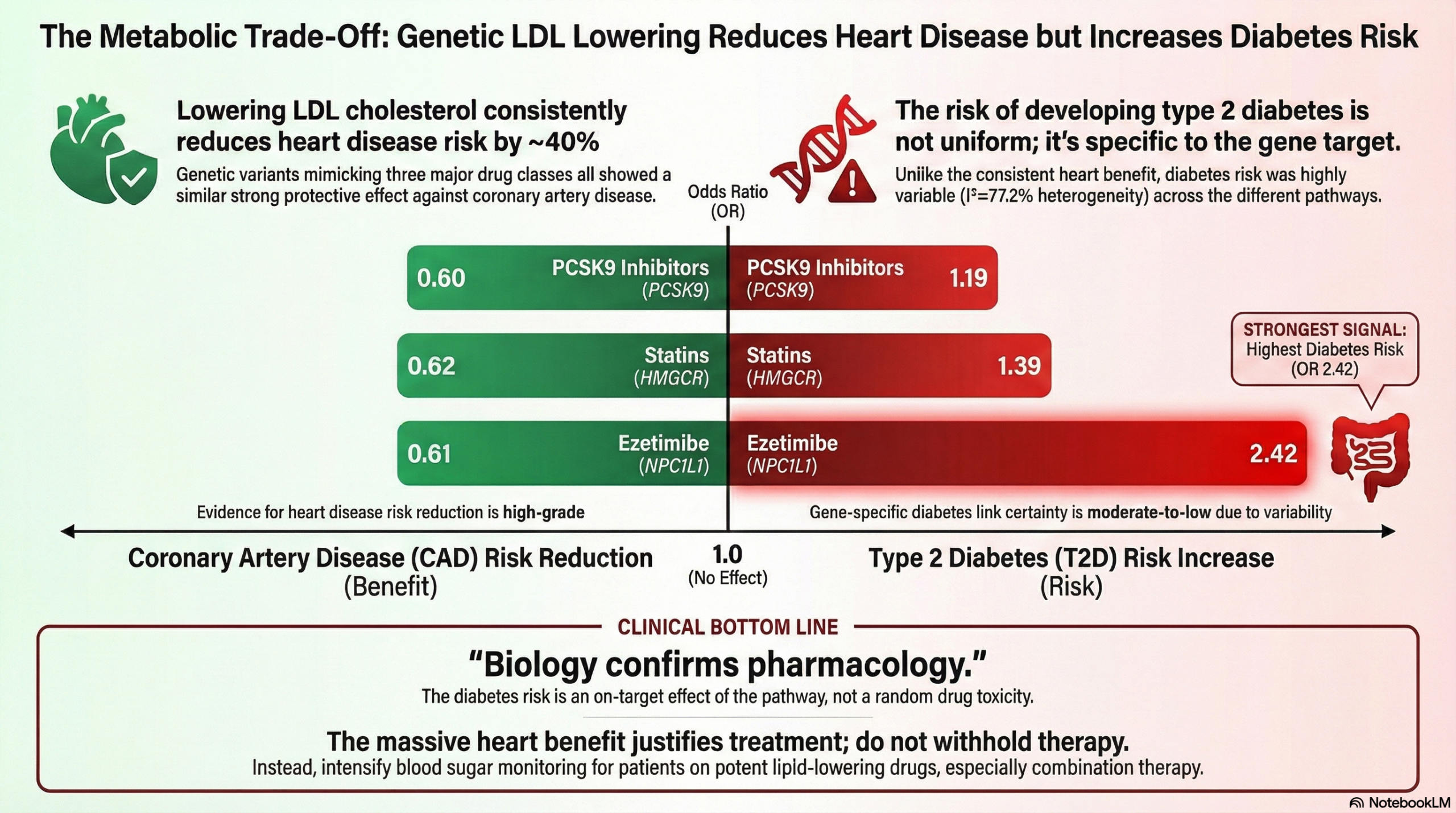
This meta-analysis provides evidence suggesting that genetic predisposition to lower low-density lipoprotein (LDL) cholesterol levels—mimicking the effects of certain lipid-lowering drugs—is associated with a higher risk of developing type 2 diabetes (T2D). This association appears to be gene-specific, contrasting with the consistent reduction in coronary artery disease (CAD) risk seen across different LDL-lowering pathways. Specifically, genetic variants near the NPC1L1 gene (the target of ezetimibe) and the HMGCR gene (the target of statins) were both significantly associated with an increased T2D risk. This finding reinforces previous concerns about the diabetogenic effect of statins and introduces a similar concern for NPC1L1 inhibitors (ezetimibe), suggesting that the adverse metabolic consequences of lipid-lowering agents may be target-specific.
Results: Summary of Results
The study used Mendelian randomization methodology to estimate the association of genetically-predicted LDL cholesterol reduction with the risk of T2D and CAD for a 1 mmol/L reduction in LDL cholesterol.
- NPC1L1 Variants: LDL-lowering genetic variants near NPC1L1 (Niemann-Pick C1-like 1, the target of ezetimibe) showed the strongest association with T2D risk.
- T2D Risk (Primary Outcome): Odds Ratio (OR) of 2.42 (95% CI, 1.70–3.43; p < 0.001) per genetically-predicted 1 mmol/L reduction in LDL cholesterol.
- CAD Risk: OR of 0.61 (95% CI, 0.42–0.88; p=0.008).
- HMGCR Variants: LDL-lowering genetic variants near HMGCR (the target of statins) were also associated with increased T2D risk.
- T2D Risk: OR of 1.39 (95% CI, 1.12–1.73; p=0.003) per genetically-predicted 1 mmol/L reduction in LDL cholesterol.
- CAD Risk: OR of 0.62 (95% CI, 0.49–0.79; p=9 \times 10^{-05}).
- PCSK9 Variants: LDL-lowering genetic variants near PCSK9 (the target of PCSK9 inhibitors) were associated with a modestly increased T2D risk.
- T2D Risk: OR of 1.19 (95% CI, 1.02–1.38; p=0.03) per genetically-predicted 1 mmol/L reduction in LDL cholesterol.
- CAD Risk: OR of 0.60 (95% CI, 0.48–0.75; p=7 \times 10^{-06}).
- Overall Heterogeneity: The association with T2D risk was highly heterogeneous across the genes examined (I2=77.2%; P=0.002), indicating that the effect on T2D is gene-specific. Conversely, the association with CAD risk was consistent across the genes (I2=0.0%; P=0.93).
An Odds Ratio (OR) represents the odds of an event occurring in one group compared to the odds in another group. An OR >1 suggests a higher odds of the outcome (T2D) in the group with the genetically-predicted LDL reduction, while an OR <1 suggests a lower odds (CAD).
Assertive Critical Appraisal: Certainty of Evidence (GRADE Framework)
While the study is a large meta-analysis utilizing genetic data, the certainty of evidence regarding the association with T2D must be interpreted with caution.
- Certainty for CAD Risk: High. The association between lower LDL cholesterol (via all genetic pathways) and reduced CAD risk was consistent and showed negligible heterogeneity (I2=0.0%). This supports the well-established causal link.
- Certainty for T2D Risk: Moderate to Low. The high degree of heterogeneity in the T2D association across genes (I2=77.2%) suggests that the association is not consistent and that the pooled estimates should be viewed with skepticism, indicating the presence of gene-specific, or pleiotropic, effects beyond LDL-cholesterol lowering. The authors’ own conclusion of “gene-specific associations” inherently downgrades the certainty of a simple LDL-lowering-T2D causal link that applies to all pathways.
Heterogeneity
The heterogeneity statistic for the association of LDL-lowering genetic variants with Type 2 Diabetes was I2=77.2% (P=0.002).
- Definition: I2 (I-squared) is the percentage of total variation across studies that is due to true differences in effect rather than chance.
- Magnitude: An I2 of 77.2% indicates substantial heterogeneity, which the authors appropriately interpret as evidence of gene-specific associations with metabolic risk. This is a critical finding, as it implies that the biological mechanism of LDL-lowering (e.g., inhibiting cholesterol absorption vs. inhibiting endogenous synthesis) is what drives the T2D risk, not merely the resulting lower LDL level itself. Therefore, the overall pooled T2D result is less meaningful than the gene-specific results, and the latter should be prioritized in clinical interpretation.
Publication Bias
The paper is a genetic meta-analysis employing Mendelian randomization using summarized data from existing genome-wide association studies (GWAS). While the text doesn’t explicitly mention the use of standard publication bias assessments like a funnel plot or Egger’s test, the data were aggregated from large, published consortia (e.g., Global Lipids Genetics Consortium, DIAGRAM, CARDIOGRAMplusC4D). Given the scale of these contributing studies (up to \sim320,000 controls for T2D), the risk of classical publication bias (i.e., small, unpublished negative studies being missed) is theoretically reduced, although not eliminated. The larger concern here is the presence of pleiotropy, which the authors did address through their heterogeneity analysis.
Risk of Bias in Included Studies
The authors acknowledge that the genetic approach, known as Mendelian randomization, generally assumes that genetic variants affect the outcome exclusively via the risk factor of interest (LDL cholesterol). The presence of strong heterogeneity in the T2D association strongly suggests this assumption is violated due to pleiotropy (the genetic variant also affecting other variables, such as BMI for HMGCR variants). The authors argue that in this context, pleiotropy may be “more informative than concerning,” as the aim was to use genetic variants to mimic the full biological action of the pharmacological therapy, which includes these off-target or downstream effects (e.g., statins affecting body weight). However, this means the result is an association between the drug target’s genetic variation and T2D, not a pure LDL-lowering effect.
Reporting Quality Assessment (PRISMA)
As a meta-analysis and genetic association study, the paper is comprehensive in its reporting of data sources:
- Search Strategy: The study utilizes publicly available summary-level results from large-scale GWAS consortia (e.g., DIAGRAM, CARDIOGRAMplusC4D, GIANT). While a traditional de novo literature search for studies is not the primary method, the sources of the summarized data are clearly cited and the selection of genetic variants is described, including the use of approximate conditional analyses to identify distinct association signals.
- Flow Diagram: The main manuscript does not include a PRISMA flow diagram, which is standard for systematic reviews to show the study selection process. However, the study relies on the pre-existing structure of established genetic consortia, and the participant numbers for the key analyses are clearly reported.
Special Consideration for Pooled Results
The high heterogeneity for the T2D association (I2=77.2%) makes the individual gene results more crucial than a pooled result. The individual-gene results (e.g., NPC1L1 OR=2.42) are strong and highly significant, despite the high heterogeneity across genes. This indicates that the association with T2D is real, but its magnitude is dependent on the specific biological pathway targeted, which is the study’s central conclusion.
Research Objective
PICO Framework:
- P (Population): Individuals of European descent.
- I (Intervention/Exposure): LDL-lowering alleles in or near genes encoding current or prospective molecular targets of lipid-lowering therapy (NPC1L1, HMGCR, PCSK9, ABCG5/G8, LDLR).
- C (Comparator): Individuals without these LDL-lowering alleles.
- O (Outcome): Risk of type 2 diabetes (T2D).
The objective was to investigate whether LDL-lowering alleles in or near NPC1L1 and other lipid-lowering drug targets are associated with the risk of T2D.
Study Design
The study was a meta-analysis of genetic association studies using a Mendelian randomization approach.
- Search Strategy and Study Selection: The associations of LDL-lowering genetic variants with T2D and CAD were investigated in meta-analyses of genetic association studies.
- T2D data were primarily gathered from the EPIC-InterAct study, UK Biobank, and the DIAGRAM consortium, with additional studies for HMGCR variants.
- Coronary artery disease (CAD) data were from the CARDIOGRAMplusC4D Consortium.
- LDL cholesterol association estimates were obtained from the Global Lipids Genetics Consortium.
- Statistical Analysis: Inverse variance weighted meta-analyses using fixed-effect models were used to pool estimates. Mendelian randomization statistical methodology was applied to estimate the association of an LDL-cholesterol reduction with the outcome, scaled to a 1 mmol/L genetically-predicted reduction. The I2 statistic was used to quantify heterogeneity.
Setting and Participants
- Setting: Data collection took place in Europe and the United States.
- Participants:
- Type 2 Diabetes Meta-analysis: Included 50,775 individuals with T2D and 270,269 controls from EPIC-InterAct, UK Biobank, and DIAGRAM.
- Coronary Artery Disease Meta-analysis: Included 60,801 individuals with CAD and 123,504 controls from the CARDIOGRAMplusC4D Consortium.
Bibliographic Data
- Title: Association Between Low-Density Lipoprotein Cholesterol–Lowering Genetic Variants and Risk of Type 2 Diabetes
- Authors: Luca A. Lotta, MD, PhD, Stephen J. Sharp, MSc, Stephen Burgess, PhD, et al.
- Journal: JAMA
- Year: 2016
- DOI: 10.1001/jama.2016.14568
Fair Use & Copyright: This post provides a transformative, thesis‑driven critical appraisal intended for educational and scholarly purposes. It is not a reproduction of, nor a market substitute for, the original research article.
Support the Version of Record: To support the copyright holders and verify the underlying data—including primary survival curves, risk estimates, and other core outcomes—readers are strongly encouraged to access the original Version of Record via the link or DOI provided above.
Medical Disclaimer: This content is for informational and educational purposes only and is not a substitute for professional medical advice, diagnosis, or treatment.