
Comment:
This study presents a fascinating potential validation of the ‘on-target’ theory regarding lipid lowering and metabolic risk. The fact that genetically mimicking PCSK9 inhibition yields the same small increase in diabetes risk as mimicking statins implies a common downstream pathway—likely intracellular cholesterol accumulation in pancreatic beta cells.
This means we should be looking at increased diabetes risk in all patients with low cholesterol, even if they are not on any medication.
The Wonk Debate – Audio Critique & Clinical Commentary:
Summary:
Clinical Bottom Line 💡
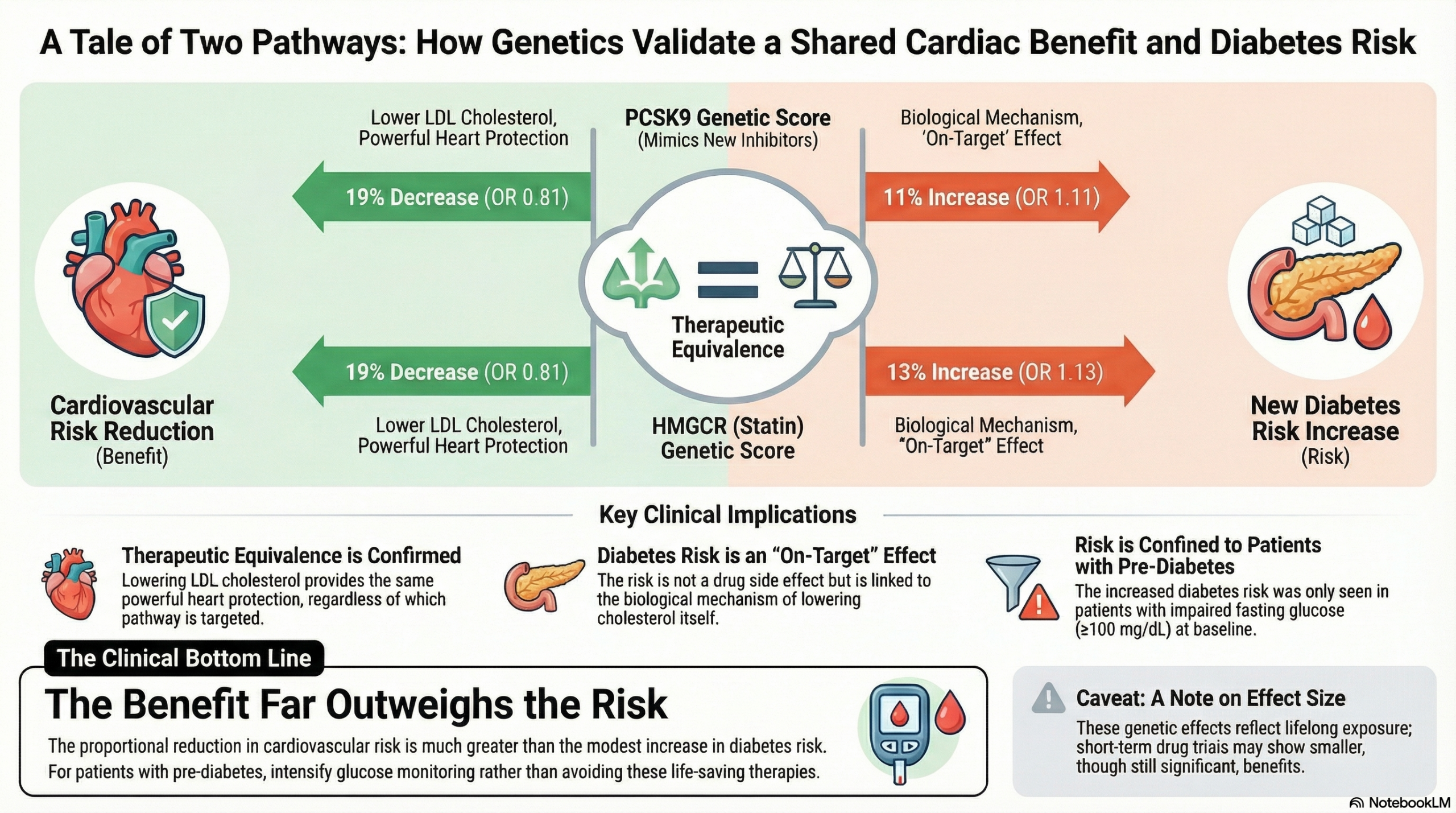
This Mendelian randomization study provides strong evidence that the lifelong genetic lowering of LDL cholesterol via variants in the PCSK9 gene (mimicking PCSK9 inhibitors) and the HMGCR gene (mimicking statins) is associated with an equivalent reduction in cardiovascular risk and a very similar, but small, increased risk of diabetes per unit decrease in LDL cholesterol level.
The association suggests that PCSK9 inhibitors should be therapeutically equivalent to statins in reducing cardiovascular events. Importantly, the increased risk of diabetes associated with both genetic scores appears limited to individuals with impaired fasting glucose levels at baseline, and the proportional reduction in cardiovascular risk is much greater than the increased risk of diabetes. The effects of both genetic variants were found to be independent and additive.
Results in Context
The study used genetic scores for PCSK9 and HMGCR as instrumental variables to assess the long-term effects of lower LDL cholesterol levels on clinical outcomes.
Main Results: Cardiovascular Events (CVD)
Lowering LDL cholesterol through PCSK9 or HMGCR variants conferred nearly identical protective effects on the risk of the primary CVD outcome (myocardial infarction or death from coronary heart disease (CHD)).
- For each 10 mg/dL (0.26 mmol/L) decrease in LDL cholesterol:
- PCSK9 variants: Odds Ratio (OR), 0.81 (95% CI, 0.74 to 0.89), representing an approximately 19% decrease in CVD risk.
- HMGCR variants: Odds Ratio (OR), 0.81 (95% CI, 0.72 to 0.90), representing an approximately 19% decrease in CVD risk.
The genetic scores had additive effects on both LDL cholesterol and the corresponding risk of cardiovascular events when present together (e.g., individuals with both scores above the median had a lower CVD risk than those with only one score above the median).
Main Results: Diabetes Risk
Lowering LDL cholesterol through PCSK9 or HMGCR variants was associated with a very similar, small increase in the risk of diabetes.
- For each 10 mg/dL (0.26 mmol/L) decrease in LDL cholesterol:
- PCSK9 variants: Odds Ratio (OR), 1.11 (95% CI, 1.04 to 1.19), representing an approximately 11% increase in diabetes risk.
- HMGCR variants: Odds Ratio (OR), 1.13 (95% CI, 1.06 to 1.20), representing an approximately 13% increase in diabetes risk.
The increased risk of diabetes was limited to persons with impaired fasting glucose (\ge 100\text{ mg/dL}) at baseline for both scores. The scores were not associated with an increased risk of incident diabetes in persons with normal fasting glucose levels. The genetic effects on diabetes risk were also additive when the scores were present together.
Assertive Critical Appraisal: Limitations & Bias (STROBE Framework)
The Mendelian randomization approach is a strength in that it mimics the random allocation of an exposure (lower LDL-C) at conception, minimizing confounding and reverse causation, similar to a lifelong randomized controlled trial. The finding that baseline nonlipid characteristics were similar between groups confirms the randomization assumption.
- Confounding: The study design inherently addresses many environmental and lifestyle confounders by using genetic variants inherited randomly. However, the authors explicitly addressed pleiotropy (when a genetic variant affects the outcome through pathways other than the intended exposure) using Mendelian randomization-Egger regression, which found no evidence for significant pleiotropic effects on the risk of CVD, suggesting the effect is indeed due to LDL cholesterol lowering.
- Pleiotropy and Weight: Unlike the HMGCR genetic score, the PCSK9 genetic score was not associated with body-mass index or weight. This is a critical distinction, as it suggests the diabetes risk from PCSK9 variants is not mediated by weight gain, potentially supporting an LDL receptor-mediated pathway as the common mechanism for the diabetes risk from both genetic scores.
- Causation: While Mendelian randomization strengthens the case for a causal relationship between lower LDL-C and the outcomes, the associations found are for lifelong exposure. The effect size is likely to be quantitatively larger than that observed with short-term pharmacologic treatment with PCSK9 inhibitors, making it an estimate of the maximum potential therapeutic benefit rather than the expected short-term effect. The final conclusion relies on the assumption of therapeutic equivalence between genetic effects and pharmacologic effects per unit change in LDL cholesterol.
Reporting Quality Assessment (STROBE)
The study provides a strong degree of transparency and detail, consistent with good reporting practices for observational studies using genetic data:
- Addressing Confounding: The use of Mendelian randomization is the primary method for addressing confounding, which is well-justified and statistically confirmed in this paper.
- Genetic Instrument Description: The paper clearly describes the construction of the genetic scores (variants \pm 100\text{ kb} of the gene, low linkage disequilibrium, weighted by effect on LDL-C), which is essential for reproducibility.
- Replication: The main findings for both CVD and diabetes were externally validated (replicated) in large independent consortia (CARDIOGRAMplusC4D and DIAGRAM), significantly increasing the credibility of the results.
Applicability
The findings are highly relevant to clinical practice as they provide strong genetic support for the long-term effectiveness and potential safety profile of PCSK9 inhibitors, particularly regarding the risk of new-onset diabetes.
- The data support the use of PCSK9 inhibitors (alone or with statins) for CVD risk reduction, suggesting a \sim 20% risk reduction per 39\text{ mg/dL} decrease in LDL cholesterol.
- The finding that the diabetes risk is confined to those with impaired fasting glucose is clinically actionable, suggesting the need for closer glucose monitoring in this subgroup when initiating PCSK9 inhibitor treatment, similar to statin therapy.
- The key limitation is that the effect sizes represent lifelong exposure and may overestimate the magnitude of benefit achieved in short-term clinical trials.
Research Objective
The objective was to use a Mendelian randomization approach to compare the effects of lower LDL cholesterol levels mediated by independently inherited genetic variants in the genes encoding proprotein convertase subtilisin-kexin type 9 (PCSK9) and 3-hydroxy-3-methylglutaryl-coenzyme A reductase (HMGCR) on the risk of cardiovascular events and the risk of diabetes.
Study Design
This was an observational study utilizing a Mendelian randomization (2\times2 factorial analysis) approach.
- Exposure: Genetic scores consisting of independently inherited LDL cholesterol-lowering variants in PCSK9 and HMGCR genes, weighted by their effect on LDL cholesterol levels.
- Outcomes:
- Primary CVD Outcome: Composite of the first occurrence of myocardial infarction or death from coronary heart disease.
- Primary Safety Outcome: Diabetes, defined as a glycated hemoglobin level >6.5% or treatment with a glucose-lowering medication.
- Statistical Analysis: Fixed-effects inverse-variance-weighted meta-analysis of study-specific estimates, with results adjusted for a standard decrement of 10\text{ mg/dL} in LDL cholesterol level.
Setting and Participants
The study included 112,772 participants from 14 prospective cohort or case-control studies.
- Total Events: 14,120 cardiovascular events and 10,635 cases of diabetes.
- Participant Source: Individual participant-level data from studies in the Database of Genotypes and Phenotypes program of the National Center for Biotechnology Information.
- Baseline Characteristics: Weighted mean age was 59.9 years. Weighted mean LDL cholesterol was 129.9\text{ mg/dL}.
Bibliographic Data
- Title: Variation in PCSK9 and HMGCR and Risk of Cardiovascular Disease and Diabetes.
- Authors: Brian A. Ference, M.D., Jennifer G. Robinson, M.D., M.P.H., Robert D. Brook, M.D., Alberico L. Catapano, Ph.D., M. John Chapman, Ph.D., David R. Neff, D.O., Szilard Voros, M.D., Robert P. Giugliano, M.D., George Davey Smith, M.D., D.Sc., Sergio Fazio, M.D., Ph.D., and Marc S. Sabatine, M.D., M.P.H.
- Journal: N Engl J Med.
- Year: 2016.
- DOI: 10.1056/NEJMoa1604304.
Original Article:
Full text: Here
Fair Use & Copyright: This post provides a transformative, thesis‑driven critical appraisal intended for educational and scholarly purposes. It is not a reproduction of, nor a market substitute for, the original research article.
Support the Version of Record: To support the copyright holders and verify the underlying data—including primary survival curves, risk estimates, and other core outcomes—readers are strongly encouraged to access the original Version of Record via the link or DOI provided above.
Medical Disclaimer: This content is for informational and educational purposes only and is not a substitute for professional medical advice, diagnosis, or treatment.