
Comment:
This review convincingly details how excess iodine drives autoimmunity at a molecular level, establishing a strong case for biological plausibility. However, it leaves us with significant uncertainty regarding when this becomes a clinical reality. Because the authors rely on a narrative overview rather than a systematic quantitative synthesis, It remains difficult to determine if this toxicity is a broad risk for the general population or if the danger is largely confined to specific, genetically susceptible groups.
The Wonk Debate – Audio Critique & Clinical Commentary:
Summary:
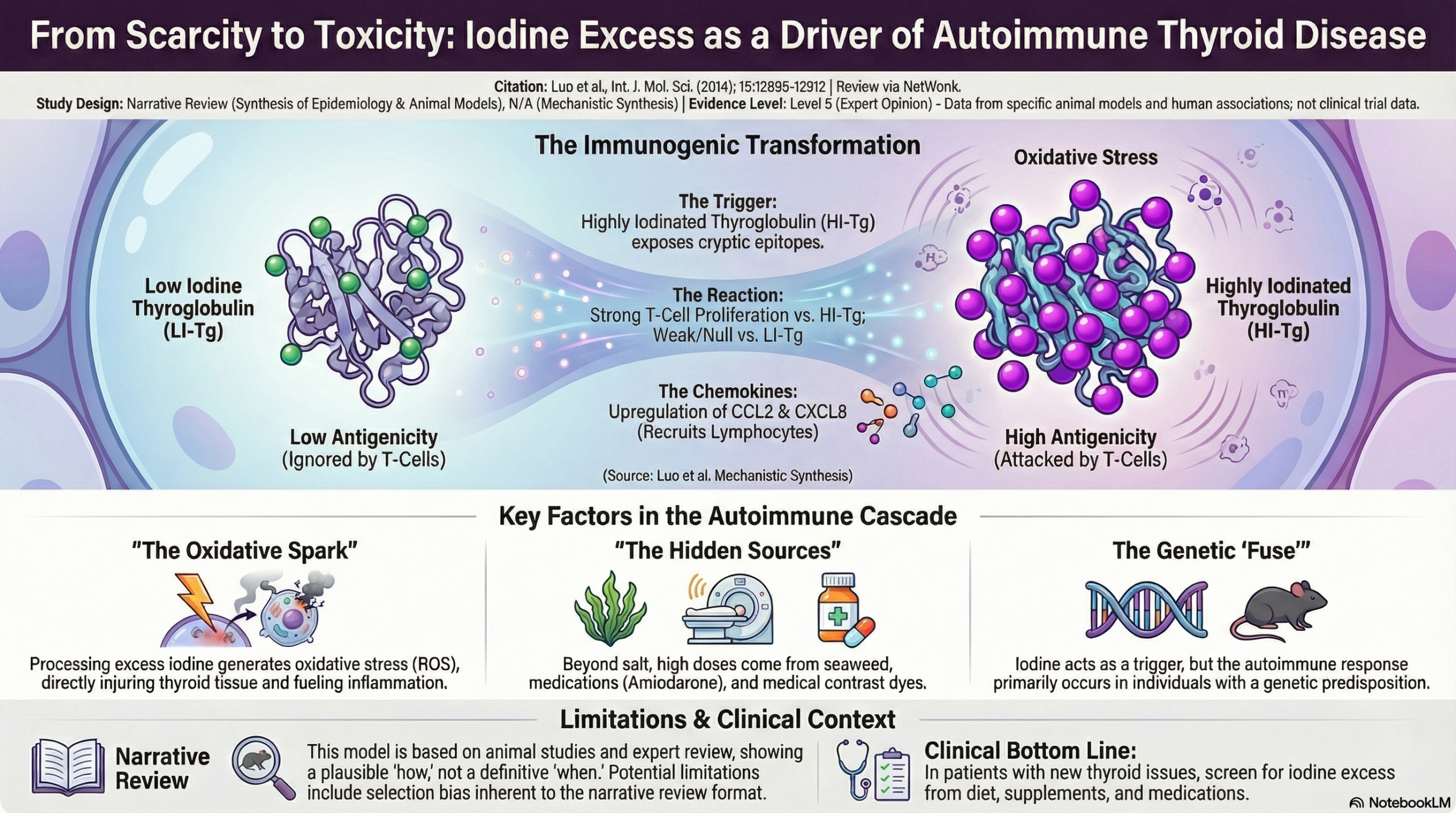
Clinical Bottom Line: This narrative review argues that while global efforts like universal salt iodization have reduced deficiency disorders, iodine excess has emerged as a frequent environmental risk factor for Autoimmune Thyroid Disease (ATD), particularly autoimmune thyroiditis. The authors contend that excessive iodine intake—whether from diet, water, or medications—precipitates thyroid autoimmunity in genetically susceptible individuals by inducing oxidative stress, recruiting immune cells to the thyroid, and increasing the immunogenicity of thyroglobulin.
Key Themes & Evidence Summary:
- Scope: The review outlines the epidemiological transition from iodine deficiency to excess, identifies diverse environmental sources of exposure (e.g., seaweed, water, medical agents), and details the molecular mechanisms linking high iodine loads to thyroid cytotoxicity and autoimmunity.
- Key Arguments:
- Epidemiological Shift: Due to variable monitoring and overlapping supplementation, iodine excess is now observed in over 30 countries.
- Diverse Sources: Significant contributors include dietary seaweed (common in Asia), naturally iodine-rich drinking water (e.g., China), and medical sources like amiodarone and iodinated contrast agents.
- Mechanisms of Disease:
- Oxidative Stress: Processing excess iodine generates Reactive Oxygen Species (ROS), leading to lipid peroxidation and thyroid tissue injury.
- Immune Recruitment: Injured thyrocytes release cytokines and chemokines (e.g., CCL2, CXCL8) that attract lymphocytes to the gland.
- Altered Antigenicity: High iodine levels result in highly iodinated thyroglobulin, which alters its conformation and increases its recognition by T-cells, thereby fueling the autoimmune response.
Assertive Critical Appraisal:
- Evidence Level: Narrative Review (Level 5 Evidence/Expert Opinion). This analysis represents a summary of expert knowledge and is susceptible to selection bias as the authors may have prioritized studies that support the link between iodine excess and ATD.
- Quality Assessment (SANRA Scale):
- Justification & Aims: High. The authors clearly justify the review by citing the global increase in iodine excess and explicitly state their objective to summarize knowledge on iodine as an environmental toxicant.
- Literature Search: Low (Flagged). The review fails to describe a systematic search strategy, databases used, or inclusion/exclusion criteria. This lack of transparency is a major limitation that prevents reproducibility and increases the risk of bias.
- Referencing: High. The arguments are supported by extensive referencing (116 citations), effectively linking epidemiological data with specific animal models (e.g., NOD.H-2h4 mice) and molecular studies.
- Scientific Reasoning: High. The authors construct a logical argument that connects epidemiological associations to biological plausibility through detailed mechanistic explanations.
- Data Presentation: Moderate. The paper relies on qualitative descriptions of mechanisms and study summaries rather than quantitative data synthesis, which is typical for a mechanistic review but limits the ability to derive specific clinical safety thresholds.
Research Objective: “This review will summarize the current knowledge regarding excess iodide as an environmental toxicant and relate it to the development of autoimmune thyroid disease.”
Bibliographic Data:
- Title: Iodine Excess as an Environmental Risk Factor for Autoimmune Thyroid Disease
- Authors: Yuqian Luo, Akira Kawashima, Yuko Ishido, Aya Yoshihara, Kenzaburo Oda, Naoki Hiroi, Tetsuhide Ito, Norihisa Ishii, Koichi Suzuki
- Journal: International Journal of Molecular Sciences
- Year: 2014
- DOI: 10.3390/ijms150712895
Original Article:
Full text: PubMed Central
Fair Use & Copyright: This post provides a transformative, thesis‑driven critical appraisal intended for educational and scholarly purposes. It is not a reproduction of, nor a market substitute for, the original research article.
Support the Version of Record: To support the copyright holders and verify the underlying data—including primary survival curves, risk estimates, and other core outcomes—readers are strongly encouraged to access the original Version of Record via the link or DOI provided above.
Medical Disclaimer: This content is for informational and educational purposes only and is not a substitute for professional medical advice, diagnosis, or treatment.