
Comment:
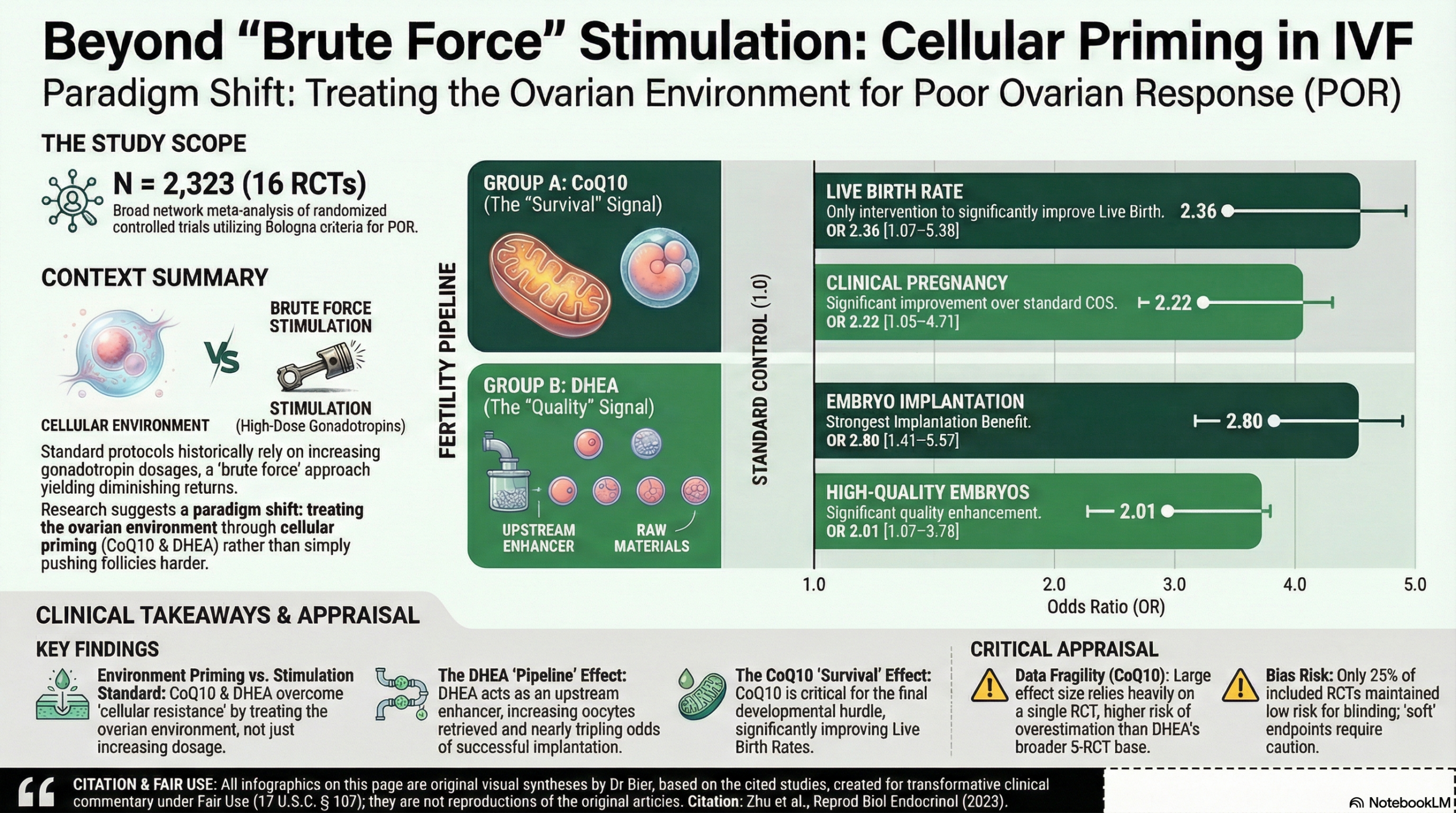
The clinical management of Poor Ovarian Response (POR) is historically a cycle of diminishing returns, often relying on aggressive gonadotropin doses that fail to overcome a depleted ovarian reserve. This network meta-analysis disrupts that paradigm, suggesting that the hardest clinical success in IVF—a live birth—is not achieved by simply pushing the ovaries harder, but by metabolic and hormonal priming of the biological environment. The clinical divergence lies in the move away from “brute force” stimulation toward intracellular support, specifically via CoQ10 and DHEA.
DHEA is the clear driver of oocyte quantity and embryo integrity in this cohort, significantly increasing the number of oocytes retrieved (WMD 1.63) and the high-quality embryo rate (OR 2.01). While CoQ10 carries the highest probability of improving the live birth rate, DHEA provides a more comprehensive strengthening of the entire IVF pipeline, from implantation to retrieval. We must acknowledge, however, that the lack of blinding in most of these trials remains a potential confounder in a field where placebo effects and subjective assessments can skew results.
The Wonk Debate – Audio Critique & Clinical Commentary:
Summary:
Clinical Bottom Line
This network meta-analysis (NMA) suggests that for patients with poor ovarian response (POR) defined by the Bologna criteria, adjuvant treatment with CoQ10, DHEA, and GH before IVF-ET can significantly improve clinical pregnancy outcomes compared to standard controlled ovarian stimulation (COS) alone. Specifically, CoQ10 demonstrated the highest efficacy for improving live birth rates (LBR) and clinical pregnancy rates (CPR). Meanwhile, DHEA showed the most robust benefit in improving embryo implantation rates, high-quality embryo rates, and the number of oocytes retrieved. However, the overall certainty of evidence is limited by a high risk of bias in blinding among included studies and a small number of trials for CoQ10 (n=1) and DHEA (n=5).
Results in Context: CoQ10 and DHEA
Primary Outcome: Clinical Pregnancy Rate (CPR)
- CoQ10: Showed the most significant advantage with an Odds Ratio (OR) of 2.22 (95% CI: 1.05 to 4.71) compared to control.
- DHEA: Followed closely with an OR of 1.92 (95% CI: 1.16 to 3.16).
- Ranking: According to SUCRA values (Surface Under the Cumulative Ranking Curve), CoQ10 ranked first (75%) and DHEA second (69%) for CPR improvement.
Secondary Outcomes
- Live Birth Rate (LBR): CoQ10 was the only adjuvant intervention of the four studied that reached statistical significance for improving LBR (OR 2.36, 95% CI: 1.07 to 5.38).
- Embryo Quality & Implantation:
- DHEA outperformed all other treatments in improving the embryo implantation rate (OR 2.80) and high-quality embryo rate (OR 2.01).
- DHEA also led to the highest increase in the number of oocytes retrieved with a Weighted Mean Difference (WMD) of 1.63.
- Cycle Canceling Rate: No adjuvant therapy, including CoQ10 and DHEA, significantly reduced the rate of cancelled cycles compared to standard COS.
Assertive Critical Appraisal
Certainty of Evidence (GRADE Assessment)
- CoQ10 Evidence: The conclusion regarding CoQ10 is based on only one RCT. While the results are statistically significant, the low number of trials and participants significantly limits the generalizability of these findings.
- DHEA Evidence: Based on five RCTs, the evidence for DHEA is more substantial than for CoQ10 but remains sensitive to the heterogeneity of the POR population.
Heterogeneity and Bias
- Risk of Bias: While 81.2% of studies used adequate random sequence generation, only 25% (4 RCTs) maintained a low risk of bias regarding blinding. The lack of blinding in infertility trials can introduce significant performance bias, particularly in assessing subjective outcomes.
- Heterogeneity: The authors used the Bologna criteria to define POR, which is a strength for reducing population heterogeneity. However, significant variability in drug doses, durations (e.g., DHEA used for 4 to 12 weeks), and specific COS protocols still existed between trials.
Special Consideration for Pooled Results
The study utilized Network Meta-Analysis (NMA), which allows for the comparison of interventions that have never been directly compared in a single head-to-head trial. Clinicians should be aware that the rankings (SUCRA values) are probabilistic; for instance, while CoQ10 is ranked “best,” this is derived from indirect evidence comparisons and a very limited primary data pool for that specific molecule.
Research Objective
To evaluate and rank the clinical efficacy of adjuvant DHEA, CoQ10, GH, and TEAS on pregnancy outcomes in patients with POR undergoing IVF-ET.
Study Design
- Type: Systematic review and network meta-analysis of randomized controlled trials (RCTs).
- Search Strategy: Search of PubMed, Embase, Cochrane Library, and four Chinese databases through July 30, 2022.
- Model: A consistency model was used as there was no significant difference between direct and indirect evidence ($P>0.05$).
Setting and Participants
- Total: 16 RCTs involving 2,323 women.
- Participants: Women diagnosed with Poor Ovarian Response (POR) specifically defined by Bologna criteria (meeting at least two of: age $\ge$ 40, previous POR $\le$ 3 oocytes, or abnormal ovarian reserve test).
- Locations: Primarily Asia (China, South Korea, Iran) and the Middle East (Egypt).
Bibliographic Data
- Title: TEAS, DHEA, CoQ10, and GH for poor ovarian response undergoing IVF-ET: a systematic review and network meta-analysis
- Authors: Fengya Zhu, Shao Yin, Bin Yang, Siyun Li, Xia Feng, Tianyu Wang, and Deya Che
- Journal: Reproductive Biology and Endocrinology
- Year: 2023
- DOI: https://doi.org/10.1186/s12958-023-01119-0
Fair Use & Copyright: This post provides a transformative, thesis‑driven critical appraisal intended for educational and scholarly purposes. It is not a reproduction of, nor a market substitute for, the original research article.
Support the Version of Record: To support the copyright holders and verify the underlying data—including primary survival curves, risk estimates, and other core outcomes—readers are strongly encouraged to access the original Version of Record via the link or DOI provided above.
Medical Disclaimer: This content is for informational and educational purposes only and is not a substitute for professional medical advice, diagnosis, or treatment.