
Animal and plant protein usual intakes are not adversely associated with all-cause, cardiovascular disease-, or cancer-related mortality risk: an NHANES III analysis


Note: All infographics on this page are original visual syntheses by Dr Bier, based on the cited studies, created for transformative clinical commentary under Fair Use (17 U.S.C. § 107); they are not reproductions of the original articles.

Comment:

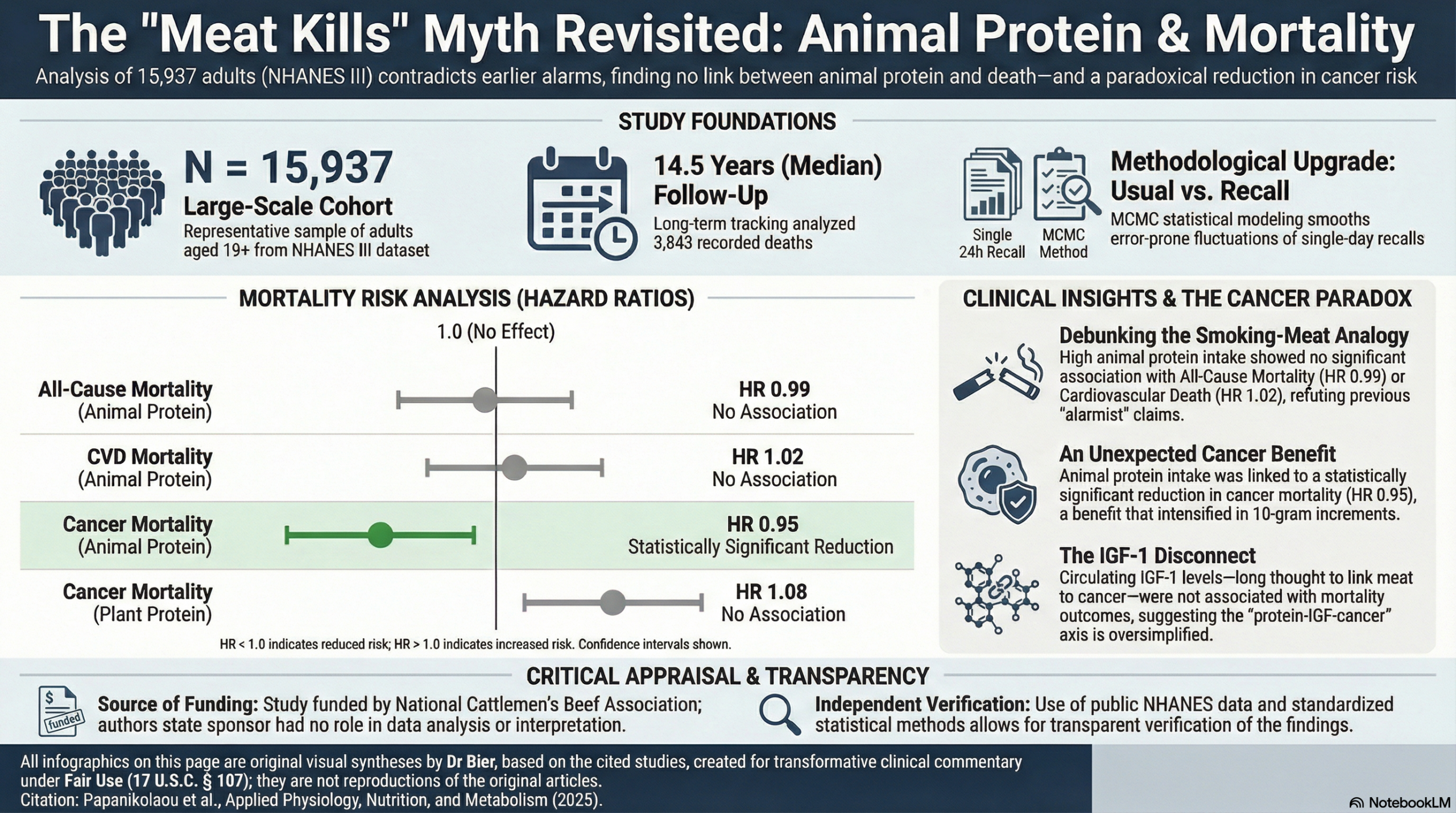
Another study showing that animal protein intake does not increase death rates. In fact, this study links higher animal protein intake to a reduced risk of cancer, albeit small. This study was designed specifically to revisit the controversial 2014 Levine findings that suggested a four-fold cancer risk from animal protein. By applying more sophisticated statistical procedures to the same NHANES III dataset, the researchers found that those alarming risks were likely artifacts of uneven group sizes and a failure to account for day-to-day dietary variation. The “meat is dangerous” signal vanishes when the data is cleaned of measurement error.

The results are a total reversal of previous claims. Not only was animal protein innocent of increasing all-cause or CVD mortality, it demonstrated a mildly protective effect against cancer (HR 0.95). Furthermore, the study confirmed that mortality risk was not associated with circulating IGF-1 in any age group, directly contradicting the theory that protein-driven IGF-1 is a mortality driver. These findings remained unchanged when separating the cohort into younger and older groups.

The clinical reality is that the fear of animal protein was built on a foundation of statistical noise. The definitive takeaway is that both animal and plant proteins are safe and appropriate for the general adult population.

Clinical Bottom Line

This large cohort study found no association between the usual intake of either animal or plant protein and the risk of death from all causes or cardiovascular disease. In a secondary finding, higher animal protein consumption was associated with a modest reduction in cancer-related mortality. These results directly challenge previous, highly publicized findings that suggested high animal protein intake was harmful, particularly for cancer risk. While this study’s use of advanced statistical methods to estimate typical dietary intake is a strength, its observational nature means it can only identify associations, not prove causation, and the potential for unmeasured confounding variables remains.


Results in Context


Main Results After adjusting for key health and lifestyle factors, the analysis showed no statistically significant link between protein intake and mortality. Specifically:

  • All-Cause Mortality: Neither animal protein intake (Hazard Ratio [HR] = 0.99) nor plant protein intake (HR = 1.02) was associated with the risk of dying from any cause.

  • Cardiovascular Mortality: Similarly, no association was found for cardiovascular death with either animal protein (HR = 1.02) or plant protein (HR = 1.01).

  • Cancer Mortality: Plant protein intake was not linked to cancer death (HR = 1.08). However, animal protein intake was associated with a small but statistically significant reduction in risk (HR = 0.95). When analyzed in 10-gram increments, this protective association became more pronounced.

  • IGF-1 Levels: Circulating levels of Insulin-like Growth Factor 1 (IGF-1), a hormone previously proposed as the mechanism linking protein to cancer, were not associated with mortality from any cause.

Definitions The primary statistic used is the Hazard Ratio (HR). An HR compares the rate of an event (in this case, death) between two groups over time.

  • An HR of 1.0 indicates no difference in risk.

  • An HR less than 1.0 suggests a lower risk in the group being studied (e.g., those with higher protein intake).

  • An HR greater than 1.0 suggests a higher risk. A result is considered statistically significant if its 95% confidence interval does not include 1.0.

Participants The analysis included a final sample of 15,937 adults aged 19 years and older, drawn from an initial pool of 19,215 individuals. Over a median follow-up of 14.5 years, there were 3,843 total deaths recorded.


Assertive Critical Appraisal


Limitations & Bias (STROBE Framework)

  • Confounding: The authors adjusted their models for several important confounders, including age, sex, physical activity level, smoking status, and total energy intake. This is a standard and necessary practice. However, the possibility of residual confounding from unmeasured variables—such as socioeconomic status, use of dietary supplements, or other healthy lifestyle behaviors correlated with protein source—cannot be eliminated.

  • Measurement Error: A significant strength of this study is its approach to dietary assessment. The authors used a sophisticated statistical technique (the MCMC method) to estimate usual dietary intake, which helps correct for the well-known errors and day-to-day variations inherent in self-reported 24-hour dietary recalls. This method is superior to simply using the raw, single-day intake data, which was a major limitation of a previous, contradictory study using the same dataset.

  • Industry Funding: The study was sponsored by the National Cattlemen’s Beef Association. The authors explicitly state that the sponsor had no role in the study design, data analysis, interpretation, or manuscript preparation. While this disclosure does not invalidate the findings, it is a potential source of conflict of interest that must be considered when evaluating the evidence.

Applicability The study uses data from NHANES III (1988-1994), a large, nationally representative sample of the US population. Although the data are several decades old, the fundamental question about protein and health remains highly relevant. The findings are broadly generalizable to the general adult population in the United States.


Research Objective

The primary goal was to re-examine the association between the usual intakes of animal and plant protein and mortality from all causes, cardiovascular disease, and cancer. The study also aimed to assess the role of IGF-1 concentrations in these potential relationships and to specifically revisit the controversial findings of a 2014 study by Levine et al. that used the same NHANES III dataset.


Study Design

This was a prospective cohort study. It utilized baseline dietary, demographic, and health data collected from participants in the Third National Health and Nutrition Examination Survey (NHANES III) between 1988 and 1994. This information was then linked to mortality data from the National Death Index through December 31, 2006.


Setting and Participants

The study was conducted using a nationally representative sample of the civilian, non-institutionalized US population. The final cohort consisted of 15,937 adults (≥19 years) who had complete and reliable data. The median follow-up period was 174 months.


Bibliographic Data

  • Title: Animal and plant protein usual intakes are not adversely associated with all-cause, cardiovascular disease-, or cancer-related mortality risk: an NHANES III analysis

  • Authors: Yanni Papanikolaou, Stuart M. Phillips, and Victor L. Fulgoni, III

  • Journal: Applied Physiology, Nutrition, and Metabolism

  • Year: 2025

  • DOI: 10.1139/apnm-2023-0594


Note: Authorship & AI Transparency: This commentary was drafted with AI assistance to support a standardized analysis, then fully reviewed, edited, and approved by Dr. Bier (WonkProject), who is the sole author responsible for its clinical content and conclusions.
Fair Use & Copyright: This post provides a transformative, thesis‑driven critical appraisal intended for educational and scholarly purposes. It is not a reproduction of, nor a market substitute for, the original research article.
Support the Version of Record: To support the copyright holders and verify the underlying data—including primary survival curves, risk estimates, and other core outcomes—readers are strongly encouraged to access the original Version of Record via the link or DOI provided above.
Medical Disclaimer: This content is for informational and educational purposes only and is not a substitute for professional medical advice, diagnosis, or treatment.