
Comment:
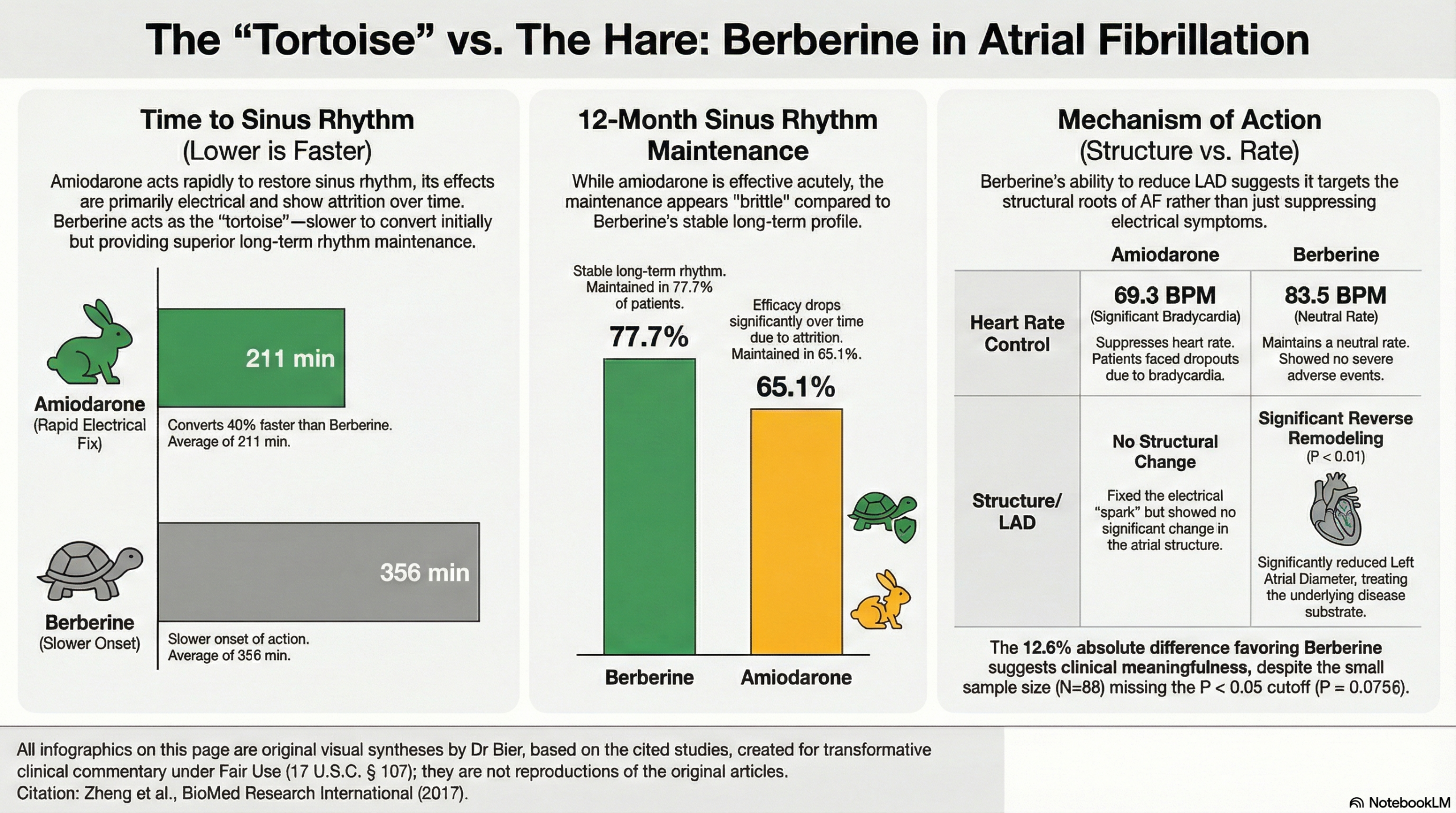
This comparison of 88 completed follow-ups shows that natural alkaloids can function as antiarrhythmics. While amiodarone converts rhythm significantly faster (211 vs. 356 minutes), it does so while maintaining a “brittle” rhythm that is more prone to attrition over time than the rhythm supported by berberine.
The statistical parity between the two agents at 12 months masks a potentially superior clinical signal for berberine. The fact that amiodarone-treated patients saw a significant decrease in sinus rhythm maintenance between 1 and 12 months (p = 0.04), while the berberine group remained stable, suggests a more durable metabolic effect. Furthermore, the unique improvement in the E/A ratio and LAD size in the berberine group points to a physiological benefit that extends beyond simple ion channel blockade.
The definitive takeaway is that we must treat the long-term maintenance of AF as a structural challenge, not just an electrical one. berberine demonstrated a statistically significant improvement from baseline in atrial diameter that was not observed in the amiodarone group.
The Wonk Debate – Audio Critique & Clinical Commentary:
Summary:
Clinical Bottom Line
This retrospective cohort study suggests that the natural alkaloid berberine may be comparable to amiodarone for long-term maintenance of sinus rhythm (SR) in patients with paroxysmal atrial fibrillation (PAF). While berberine has a slower onset of action for acute conversion and lacks amiodarone’s heart rate-lowering effects, it demonstrated sustained efficacy from 1 month through 12 months. Notably, berberine was uniquely associated with signs of reverse atrial remodeling (reduced left atrial diameter). However, because this is a retrospective study with a small sample size, these findings should be viewed as hypothesis-generating, particularly regarding the claim of “no difference” between the two agents.
Results in Context
- Main Results: Throughout the follow-up period, there was no statistically significant difference in the conversion and maintenance of sinus rhythm between groups. At 1 month, rates were 66.6% (berberine) vs. 72% (amiodarone); this parity was maintained at 12 months with 77.7% vs. 65.1% respectively (p = 0.0756 after adjustment).
- Definitions: The p-value of 0.0756 indicates that the observed difference between the groups did not reach the standard threshold for statistical significance (p < 0.05), meaning we cannot definitively state one drug performed better than the other in this specific cohort.
- Key Secondary Outcomes:
- Time to Conversion: Berberine took significantly longer to achieve initial SR than amiodarone (356 ± 135 min vs. 211 ± 126 min, p < 0.01).
- Heart Rate Control: The average heart rate in SR was significantly higher in the berberine group (83.5 ± 11.6 bpm) compared to amiodarone (69.3 ± 12.5 bpm, p < 0.01).
- Echocardiographic Remodeling: Berberine treatment led to a significant reduction in left atrial diameter (LAD) at 6 and 12 months, whereas amiodarone did not. This suggests a potential structural benefit of berberine on the atrial tissue.
- Participants: 96 patients were initially matched; 45 in the berberine group and 43 in the amiodarone group completed the full 12-month follow-up.
Assertive Critical Appraisal
- Limitations & Bias (STROBE Framework):
- Imprecision/Power: While the results show “no difference” from 1 to 12 months, the small sample size (n=88 total) makes the study underpowered to detect a true clinical difference. The 12.6% numerical advantage for berberine at 12 months might have reached significance in a larger trial.
- Selection Bias: The study used a per-protocol analysis, excluding patients who did not complete the 12-month course. This can bias results, as patients who stop a drug due to side effects (more common with amiodarone) are not factored into the final efficacy rate.
- Reporting Quality Assessment (STROBE): The authors used a Cox proportional hazard model to adjust for confounders, which is appropriate for time-to-event data. However, they failed to provide a formal power calculation, leaving it unclear if the “no difference” finding is due to true equivalence or simply a trial that was too small to see a difference.
- Applicability: Berberine appears to be a viable long-term “rhythm control” option for patients seeking natural alternatives or those with contraindications to amiodarone. However, it is not an appropriate substitute for acute rate control or rapid conversion in a hemodynamically unstable setting.
Research Objective
To evaluate the efficacy and safety of berberine compared to amiodarone for the conversion and 12-month maintenance of sinus rhythm in patients with paroxysmal atrial fibrillation.
Study Design
Matched retrospective cohort study. The berberine group received 1.3 g/day; the amiodarone group followed a standard loading and maintenance dose (0.6 g tapering to 0.2 g/day).
Setting and Participants
- Setting: Shanghai Xuhui Central Hospital, China (2013–2014).
- Eligibility: Patients aged 20–80 with symptomatic PAF. Exclusion criteria included structural heart disease, thyroid dysfunction, and severe hepatic/renal impairment.
Bibliographic Data
- Title: Antimicrobial Natural Product Berberine Is Efficacious for the Treatment of Atrial Fibrillation
- Authors: Zheng H, Zhu F, Miao P, Mao Z, Redfearn DP, Cao RY.
- Journal: BioMed Research International
- Year: 2017
- DOI: 10.1155/2017/3146791
Fair Use & Copyright: This post provides a transformative, thesis‑driven critical appraisal intended for educational and scholarly purposes. It is not a reproduction of, nor a market substitute for, the original research article.
Support the Version of Record: To support the copyright holders and verify the underlying data—including primary survival curves, risk estimates, and other core outcomes—readers are strongly encouraged to access the original Version of Record via the link or DOI provided above.
Medical Disclaimer: This content is for informational and educational purposes only and is not a substitute for professional medical advice, diagnosis, or treatment.