
Comment:
The data presented in this systematic review and meta-analysis of 242,095 participants reveals a stark collision between the biochemical promise of intermittent fasting (IF) and the hard reality of epidemiological survival. While IF is frequently promoted as a metabolic panacea—citing mechanisms like autophagy and improved insulin sensitivity—these theories often ignore the hierarchy of harm: actual human survival. Mechanistic studies suggest benefit, yet we must reconcile this with the persistent mortality signals appearing in large-scale human models.
The Core Tension: Mechanism vs. Survival
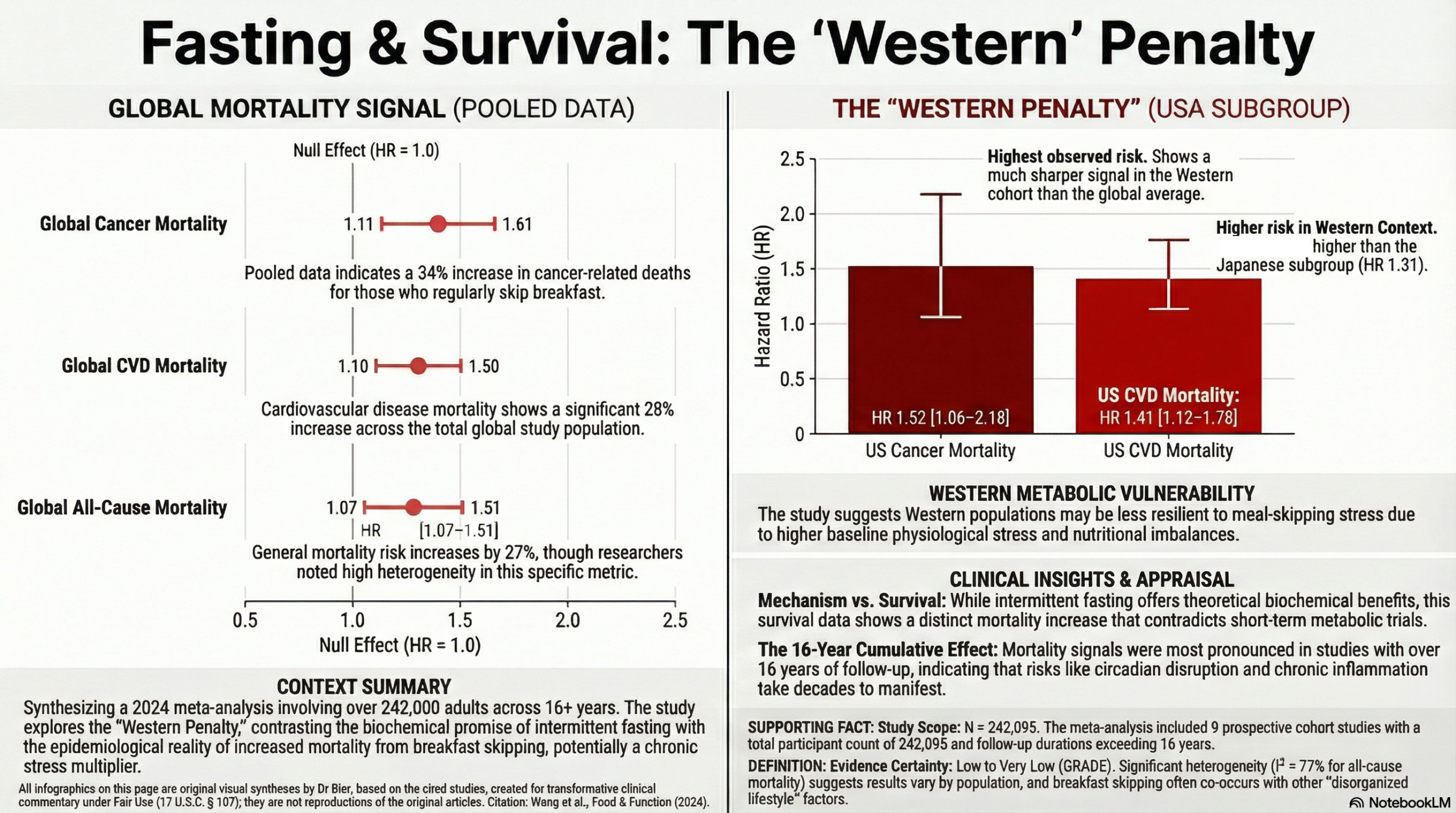
This analysis disrupts the “fasting is harmless” narrative by prioritizing hard clinical endpoints over surrogate markers like weight or glucose. The data identifies a specific, distinct risk profile for those skipping breakfast:
- All-Cause Mortality: A significant 27% increase (HR 1.27).
- CVD Mortality: A 28% increase (HR 1.28).
- Cancer Mortality: A distinct 34% increase (HR 1.34).
Geographical Signals and the Western Context
The concern is significantly strengthened when looking at the subgroup analyses. The deleterious associations of breakfast skipping were primarily evident in North American populations, whereas studies from Japan did not observe the same significant associations. This discrepancy suggests that the “Western” dietary pattern—often characterized by higher physiological stress and specific nutritional imbalances—may be more susceptible to the harms of breakfast skipping than other dietary cultures. Furthermore, the mortality signals were more pronounced in high-quality studies and those with over 16 years of follow-up, suggesting that the “hard endpoints” of this habit take decades to fully manifest.
Hard Clinical Realities
These findings are not minor fluctuations in biomarkers; they are definitive signals that the physiological stress of skipping breakfast—likely driven by circadian disruption and chronic inflammation—may outweigh the theoretical benefits of caloric restriction in a general population. While breakfast skipping represents a natural form of fasting, it is a protocol that, in this data, appears guilty of potential harm until proven otherwise.
The burden of proof lies on fasting advocates to demonstrate Overall Survival efficacy. Until then, intentional fasting that skips the morning meal should be viewed with skepticism, as it is currently associated with increased risks of cancer, cardiovascular, and all-cause mortality in the very populations where it is most popular.
The Wonk Debate – Audio Critique & Clinical Commentary:
Summary:
Clinical Bottom Line
This systematic review and meta-analysis suggests that skipping breakfast is associated with a significantly increased risk of all-cause, cardiovascular (CVD), and cancer mortality in general adult populations. However, regarding your specific interest in Time Restricted Eating (TRE): It is critical to distinguish between the “breakfast skipping” behavior analyzed here and intentional, structured TRE. The authors note that while breakfast skipping technically constitutes a form of prolonged fasting, in observational cohorts, it is often a proxy for an “unhealthy lifestyle,” co-occurring with smoking, alcohol consumption, and sedentary behavior . Therefore, these findings likely reflect the risks of a disorganized dietary pattern rather than the potential risks or benefits of therapeutic Time Restricted Eating. The certainty of this evidence is rated Low to Very Low, and the associations for all-cause and CVD mortality were unstable in sensitivity analyses.
Results
- Summary of Results: The meta-analysis pooled data from 9 prospective cohort studies involving 242,095 participants. The pooled hazard ratios (HR) comparing breakfast skippers to regular consumers were:
- All-Cause Mortality: HR 1.27 (95% CI 1.07-1.51).
- CVD Mortality: HR 1.28 (95% CI 1.10-1.50).
- Cancer Mortality: HR 1.34 (95% CI 1.11-1.61).
- Proposed Mechanism: The authors propose that long-term breakfast skipping may trigger chronic inflammation and disrupt the gene expression of biological clocks (circadian rhythms), leading to metabolic dysfunction. This contrasts with other literature cited in the discussion suggesting intermittent fasting may improve metabolic health.
Assertive Critical Appraisal
- Certainty of Evidence (GRADE Framework): The overall quality of evidence was rated as Very Low for all-cause mortality and Low for CVD and cancer mortality. This indicates that the true effect is likely to be substantially different from the estimate of the effect provided in this paper.
- Heterogeneity:
- There was substantial heterogeneity for all-cause mortality (I^2 = 77\%, p < 0.01), meaning the included studies showed widely varying results. This high variation makes the pooled HR of 1.27 less reliable.
- Conversely, CVD and Cancer mortality showed low heterogeneity (I^2 = 0%).
- Sensitivity and Stability of Results: A critical weakness identified in this analysis is instability.
- For All-Cause Mortality: Excluding specific studies (e.g., Yokoyama et al. or Kaplan et al.) rendered the results non-significant.
- For CVD Mortality: Excluding the studies by Sun et al. or Tang et al. also made the association non-significant.
- This suggests the “risk” is heavily driven by specific datasets rather than a universal trend across all cohorts.
- Confounding Variables (Lifestyle vs. Fasting): This is the most significant limitation regarding TRE. While most studies adjusted for age and sex, adjustments for total energy intake and physical activity varied. The authors admit that breakfast skipping is usually accompanied by other unhealthy lifestyles (sedentary behavior, smoking, alcohol), which act as confounders. This makes it difficult to isolate the physiological effect of “fasting” from the general health profile of a “skipper.”
- Publication Bias: The authors assessed for publication bias using funnel plots and Egger’s tests and reported no significant publication bias for all-cause (p=0.51) or CVD mortality (p=0.95).
- Reporting Quality (PRISMA): The review adhered to the PRISMA checklist.
Research Objective
The study aimed to elucidate the associations between breakfast skipping and the risk of all-cause, cardiovascular disease (CVD), and cancer mortality in general adult populations through a systematic review and meta-analysis.
Study Design
- Design: Systematic review and meta-analysis of prospective cohort studies.
- Search Strategy: Databases (PubMed, Embase, Web of Science) searched up to July 2023.
- Study Selection: Included prospective cohort studies on adults \ge 18 years reporting risk estimates (HR, RR, OR) for mortality based on breakfast consumption frequency.
Setting and Participants
- Total Participants: 242,095 individuals included in the final analysis.
- Locations: The studies were conducted in the United States (5 studies), Japan (3 studies), and Canada (1 study).
- Follow-up: Most included studies had a follow-up duration of more than 16 years.
Bibliographic Data
- Title: Breakfast skipping and risk of all-cause, cardiovascular and cancer mortality among adults: a systematic review and meta-analysis of prospective cohort studies
- Authors: Wang Y, Li F, Li X, Wu J, Chen X, Qin T, Liu X, Liang L, Ma J, Qin P
- Journal: Food & Function
- Year: 2024
- DOI: 10.1039/d3fo05705d
Fair Use & Copyright: This post provides a transformative, thesis‑driven critical appraisal intended for educational and scholarly purposes. It is not a reproduction of, nor a market substitute for, the original research article.
Support the Version of Record: To support the copyright holders and verify the underlying data—including primary survival curves, risk estimates, and other core outcomes—readers are strongly encouraged to access the original Version of Record via the link or DOI provided above.
Medical Disclaimer: This content is for informational and educational purposes only and is not a substitute for professional medical advice, diagnosis, or treatment.