
Comment:
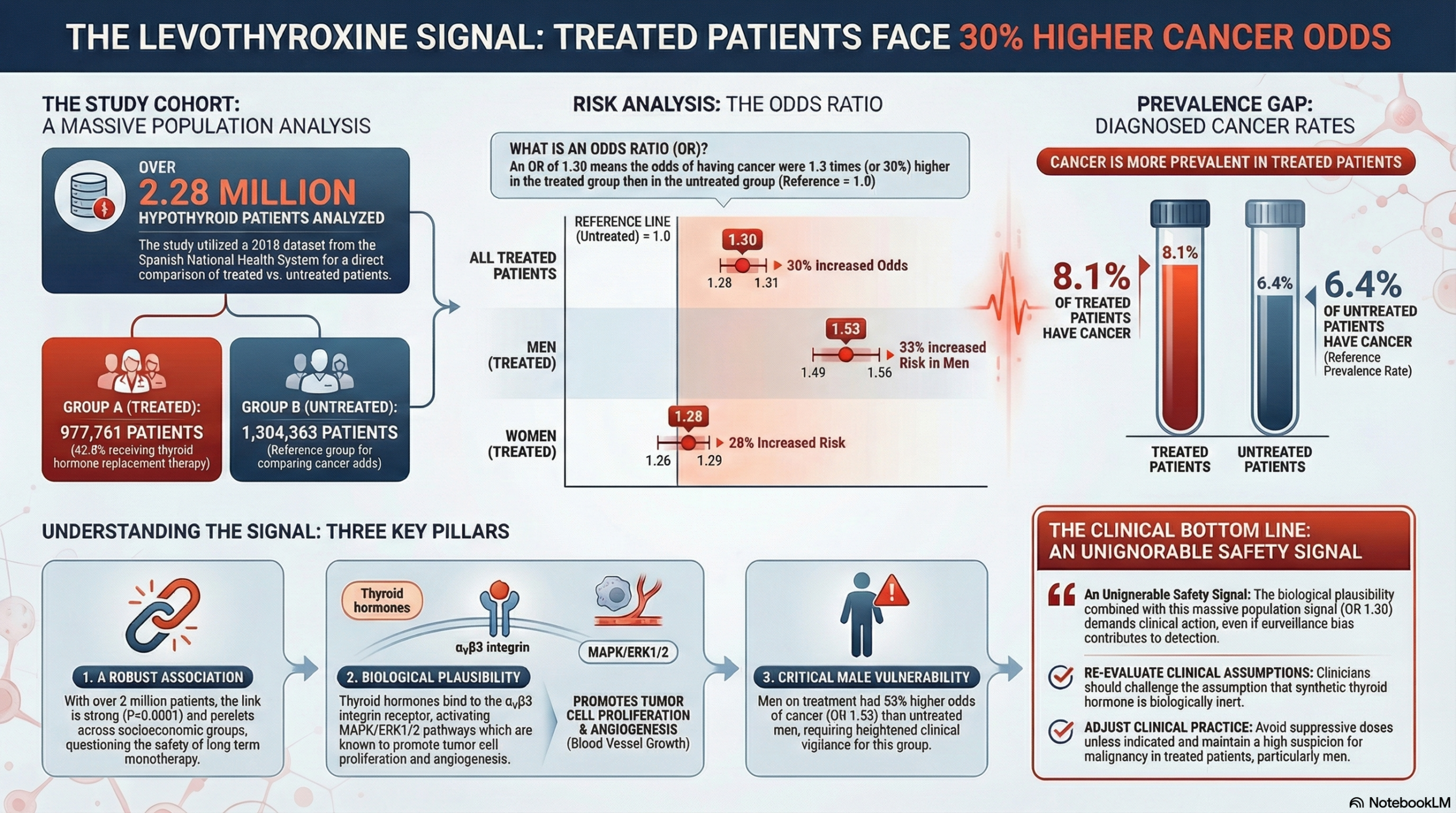
This is another in a growing group of studies showing a correlation between levothyroxine (synthetic T4) use and increased cancer risk. What makes this analysis particularly compelling is the direct comparison between treated and untreated patients with hypothyroidism. While we must respect the limitations of observational data, we must also be pragmatic: we are unlikely to ever see a randomized trial comparing thyroxine to placebo or DTE. When this many safety signals point in the same direction, we cannot simply wait for ‘perfect’ data; we need to re-evaluate the assumption that synthetic thyroid monotherapy is safe.
The Wonk Debate – Audio Critique & Clinical Commentary:
Summary:
Clinical Bottom Line
This large, population-based observational study demonstrates a robust association between hypothyroidism and an increased risk of overall cancer (OR 1.73). Regarding your specific interest in exogenous thyroxine, the study found that hypothyroid patients receiving thyroid hormone replacement therapy had a significantly higher risk of cancer compared to untreated hypothyroid patients (OR 1.30).
However, this finding must be interpreted with significant caution. It does not necessarily prove that the medication causes cancer. It is highly probable that patients requiring treatment have more severe thyroid dysfunction or more frequent medical contact (surveillance bias) than those who remain untreated. Consequently, while the statistical association is strong, a causal link between exogenous thyroxine and malignancy cannot be established from this data.
Results in Context
- Impact of Thyroid Hormone Replacement Therapy:
- Increased Risk in Treated Patients: The study analyzed 977,761 patients on replacement therapy (specifically Group H03 drugs, including sodium levothyroxine). The prevalence of malignancy in these treated patients was 8.99%, compared to 6.36% in untreated hypothyroid patients.
- Statistical Significance: This difference resulted in an Odds Ratio (OR) of 1.30 (95% CI: 1.28–1.31; $P<0.0001$), indicating a 30% higher odds of cancer diagnosis in the treated group compared to the untreated group.
- Gender Differences: The relative risk associated with treatment was higher in men (OR 1.53) than in women (OR 1.28), though both were statistically significant.
- Age Factor: The increased risk associated with treatment persisted even in patients aged 65 and older (OR 1.03), though the magnitude of the risk was lower than in younger cohorts.
- Overall Hypothyroidism and Cancer Risk:
- General Association: Hypothyroidism (regardless of treatment status) was associated with an overall increased risk of cancer compared to the non-hypothyroid population (OR 1.73).
- Specific Cancers: The highest relative risks were observed for thyroid cancer (OR 5.07), respiratory tract cancer (OR 1.83), and renal cancer (OR 1.52).
- Definitions:
- Odds Ratio (OR): An OR of 1.30 means the odds of having cancer were 1.3 times higher in the treated group than in the untreated group.
- Replacement Therapy: Defined in this study as anatomical group H (hormones), therapeutic subgroup H03, including sodium levothyroxine and liothyronine.
Assertive Critical Appraisal
- Limitations & Bias (STROBE Framework):
- Confounding by Indication (Critical Flaw): The authors speculate that the increased risk in treated patients may be due to this subgroup having a “more marked degree of thyroid hormone deficiency” compared to untreated patients who may have mild or transient subclinical hypothyroidism. The study design cannot adjust for disease severity, making it impossible to separate the effect of the drug from the severity of the underlying condition.
- Surveillance Bias: Patients on long-term replacement therapy require regular monitoring and physician visits. This increased contact with the healthcare system makes them more likely to be screened for and diagnosed with cancer compared to untreated individuals or the general population.
- Missing Clinical Details: The study lacks critical data regarding the duration of replacement therapy, the dosage used, and the degree of hormonal control (TSH levels). Without knowing if higher doses or longer duration correlate with higher risk, the association remains purely observational.
- Etiology Unknown: The database does not distinguish the cause of hypothyroidism (e.g., autoimmune vs. post-surgical). If a patient is hypothyroid due to previous cancer treatment (e.g., neck radiation), their risk of secondary malignancies is inherently higher regardless of thyroxine therapy.
- Reporting Quality Assessment (STROBE):
- The authors transparently acknowledge that they could not account for family history, dietary factors, or other relevant confounders in carcinogenesis.
- The study fails to provide a breakdown of specific cancer types within the treated vs. untreated comparison, limiting the analysis to “overall cancer” risk for the treatment subgroup.
- Applicability:
- The findings are highly generalizable to the Spanish population due to the massive sample size (over 2.4 million hypothyroid patients). However, the lack of granularity regarding the type of hypothyroidism limits the clinical application of the risk data to individual patients.
Research Objective
The study aimed to determine the association between hypothyroidism and overall and site-specific cancer in the Spanish population, and secondarily, to analyze if this risk is modified by thyroid hormone replacement therapy.
Study Design
- Design: Observational, retrospective, cross-sectional study.
- Data Source: BDCAP (Base de Datos Clínicos de Atención Primaria), a standardized clinical database representing the Spanish National Health System.
- Period: Data collected for the year 2019.
Setting and Participants
- Setting: Primary care level records throughout Spain.
- Participants:
- Total population with registered health problems: 38,365,258.
- Patients with hypothyroidism: 2,414,165 (6.29% of the population).
- Patients on thyroid hormone replacement therapy: 977,761 (42.84% of hypothyroid patients).
Bibliographic Data
- Authors: Díez JJ, Iglesias P.
- Journal: PLoS ONE
- Year: 2022
- DOI: 10.1371/journal.pone.0275568
Original Article:
Full text: PubMed Central
Fair Use & Copyright: This post provides a transformative, thesis‑driven critical appraisal intended for educational and scholarly purposes. It is not a reproduction of, nor a market substitute for, the original research article.
Support the Version of Record: To support the copyright holders and verify the underlying data—including primary survival curves, risk estimates, and other core outcomes—readers are strongly encouraged to access the original Version of Record via the link or DOI provided above.
Medical Disclaimer: This content is for informational and educational purposes only and is not a substitute for professional medical advice, diagnosis, or treatment.