
Comment:
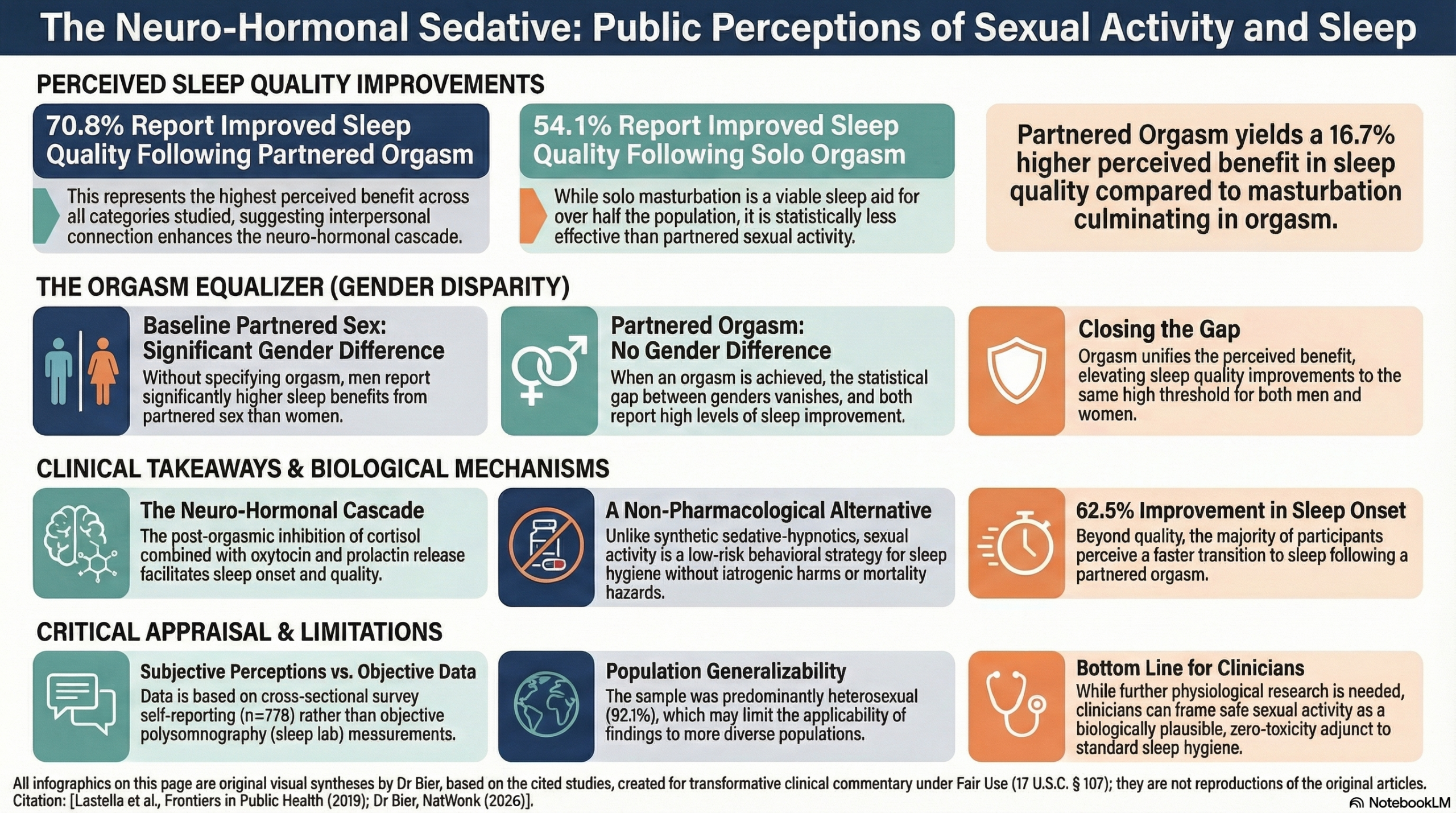
Although this study uses perception of sleep versus measured metrics and could suffer from recall bias, I tend to trust people’s perception of how well they sleep, and this one shows significant improvements with sexual activity. Gender differences in sleep perception exist for partnered sex alone, however these disparities effectively vanish if an orgasm is achieved. For both men and women, the perception of improved sleep quality rises to 70.8% following partnered orgasm while masturbation with orgasm improved sleep quality for 54.1% of respondents. The combined inhibition of cortisol and the post-orgasmic surge of oxytocin and prolactin suggests a specialized neuro-hormonal state optimized for sleep.
This also needs to be contrasted with studies on sleep medications, that show the potential for significant harms.
The Wonk Debate – Audio Critique & Clinical Commentary:
Summary:
Clinical Bottom Line
This cross-sectional survey indicates a strong public perception—particularly among men—that sexual activity with a partner improves sleep quality and onset. However, when an orgasm is achieved, gender differences in these perceptions disappear, with the majority of both men and women reporting favorable sleep outcomes. While masturbation is also perceived to aid sleep, the effect is reported as less pronounced than sex with a partner. Clinicians may consider discussing safe sexual activity as a potential behavioral strategy for sleep hygiene, though it is important to note these findings reflect patient perceptions rather than objective physiological measurements.
Results in Context
- Main Results:
- Sex with a Partner: 63.1% of respondents perceived improved sleep quality, and 59.0% perceived improved sleep onset.
- Orgasm with a Partner: Perception of improvement rose to 70.8% for sleep quality and 62.5% for sleep onset.
- Masturbation with Orgasm: 54.1% reported improved sleep quality, and 47.4% reported improved sleep onset.
- Definitions:
- Sleep Latency: The amount of time (in minutes) it usually takes to fall asleep.
- Chi-square Analysis: A statistical test used to determine if there is a significant difference between the expected frequencies and the observed frequencies in one or more categories.
- Participants: 778 adults participated (442 females, 336 males) with a mean age of 34.5±11 years.
Assertive Critical Appraisal
- Limitations & Bias (STROBE Framework):
- Self-Report Bias: The study relies entirely on subjective perceptions and recall over the “past month,” which is susceptible to recall bias and social desirability bias regarding sensitive topics.
- Causality: As a cross-sectional survey, the study can only identify associations; it cannot prove that sexual activity causes improved sleep.
- Non-Response Bias: The completion rate was 66%, suggesting that individuals who chose not to complete the survey might have different sexual behaviors or sleep patterns than those who did.
- Reporting Quality Assessment (STROBE): The authors clearly describe the recruitment via social media and the use of snowball sampling. However, the study’s reliance on a convenience sample of predominantly heterosexual participants (92.1%) limits the generalizability of the findings to more diverse populations. The authors acknowledge the sensitive nature of the topic and attempted to mitigate bias by including honesty and embarrassment indicators at the conclusion of the survey.
- Applicability: These findings are highly relevant to general practice as they highlight a common, non-pharmacological behavior that patients already perceive as beneficial for sleep. However, the lack of objective data (like polysomnography) means clinicians should frame this as a “perceived benefit” rather than a clinically proven treatment for insomnia.
Research Objective
To explore the perceived relationship between various sexual activities (sex with a partner vs. masturbation, with and without orgasm), sleep quality, and sleep latency in the general adult population, specifically looking for gender differences.
Study Design
This was a cross-sectional, anonymous online survey conducted between October 2016 and June 2017. It utilized validated items from the Australian Study of Health and Relationships and the Pittsburgh Sleep Quality Index (PSQI).
Setting and Participants
- Setting: Online survey promoted via social media (Twitter, Facebook) and professional networks.
- Participants: 778 volunteers aged 18+.
- Key Demographics: 56.8% female; 92.1% heterosexual; 39.8% married; 69.5% in a regular relationship living together.
Bibliographic Data
- Title: Sex and Sleep: Perceptions of Sex as a Sleep Promoting Behavior in the General Adult Population
- Authors: Michele Lastella, Catherine O’Mullan, Jessica L. Paterson, and Amy C. Reynolds
- Journal: Frontiers in Public Health
- Year: 2019
- DOI: 10.3389/fpubh.2019.00033
Fair Use & Copyright: This post provides a transformative, thesis‑driven critical appraisal intended for educational and scholarly purposes. It is not a reproduction of, nor a market substitute for, the original research article.
Support the Version of Record: To support the copyright holders and verify the underlying data—including primary survival curves, risk estimates, and other core outcomes—readers are strongly encouraged to access the original Version of Record via the link or DOI provided above.
Medical Disclaimer: This content is for informational and educational purposes only and is not a substitute for professional medical advice, diagnosis, or treatment.